
14. September 2026
The Vision Behind the Knowledge Platform
“The future belongs not to the companies with the best tools, but to those whose knowledge is accessible to both people and machines.” Maximilian Gärber is certain of this. As a Principal Technical Consultant and the visionary behind the semantic knowledge platform PANTOPIX SPHERE, he has long been grappling with one of the biggest challenges facing nearly every company. “With his famous saying, ‘If Siemens knew what Siemens knows,’ Heinrich von Pierer articulated the central problem of modern knowledge management around the turn of the millennium—in other words, half an eternity ago,” says Max Gärber. And this issue is just as relevant today as it was back then: Companies struggle with fragmented product knowledge, heterogeneous system landscapes, and data silos. The problem is exacerbated by the fact that valuable expert knowledge is often not recorded in systems at all. If it resides solely in the minds of employees in development, sales, service, or product management, it can be lost entirely when individual employees leave the company.
“At PANTOPIX, too, this issue has been with us from the very beginning. As an integration partner, our customers repeatedly brought us back to the same pain point: the need to connect different systems and incompatible data structures. It wasn’t a single customer project that sparked the development of PANTOPIX SPHERE, but rather the one central problem that all companies faced,” explains Max Gärber. “Our solution is a platform for the semantic integration of all information related to the lifecycle of a technical product. It was particularly important to us to design PANTOPIX SPHERE as a highly flexible platform that connects these different information ecosystems and creates a shared semantic knowledge base from them.”
Technical Features of PANTOPIX SPHERE
Semantics as a Fundamental Architectural Principle
“The most distinctive feature of PANTOPIX SPHERE is its use of semantic AI, and that was also the biggest hurdle for us during development,” said Max Gärber. Semantic AI brings together two types of artificial intelligence that are actually fundamentally different: symbolic AI (graph technology) and non-symbolic AI (large language models / LLMs).
Large language models recognize patterns and generate responses based on statistical probabilities. This makes them powerful when dealing with language and unstructured content. Graph technology—that is, a knowledge graph—works, by contrast, with explicitly modeled entities, facts, relationships, and rules. It can transparently map which pieces of information are connected to which others and derive new insights from them. For example, a language model can determine that two phrases likely mean the same thing. A graph cannot assume such a similarity. The relationship must be modeled, verified, or derived from defined rules.
“The interaction between these two types of AI is extremely important for our Knowledge Platform in verifying the accuracy of answers,” explains Max Gärber. “From a technological standpoint, it was an enormous challenge to combine the two. It only works by always using each technology where it excels. You can think of it like a relay race between a dolphin and a lion. The dolphin is extremely capable in the water, and the lion on land. Only together can they cover a route with both water and land sections—a route that each would fail to complete on its own. But this only works if it’s precisely defined where one takes over and how the handoff works. So the challenge for us was to create suitable handoff points: Where do we leverage the flexibility of an LLM, and where do we need the controlled logic of the knowledge model?”
The combination of semantic technology with an LLM—that is, the so-called GraphRAG approach—is not an AI feature added as an afterthought, but rather follows the fundamental architecture of PANTOPIX SPHERE. From the very beginning, the platform was designed to overlay a semantic layer on existing information sources and use it to build a knowledge graph. Max Gärber clearly distinguishes this method from the Retrieval-Augmented Generation (RAG) approach, which is now often used for corporate data: “We neither apply language models to data in isolation nor, as with the classic RAG approach, simply provide relevant content as additional context. With GraphRAG, we give the LLM access to semantically interconnected knowledge—that is, to information, its meaning, its relationships to other information, and the company-specific context in which it exists.”
Flexible Data Integration
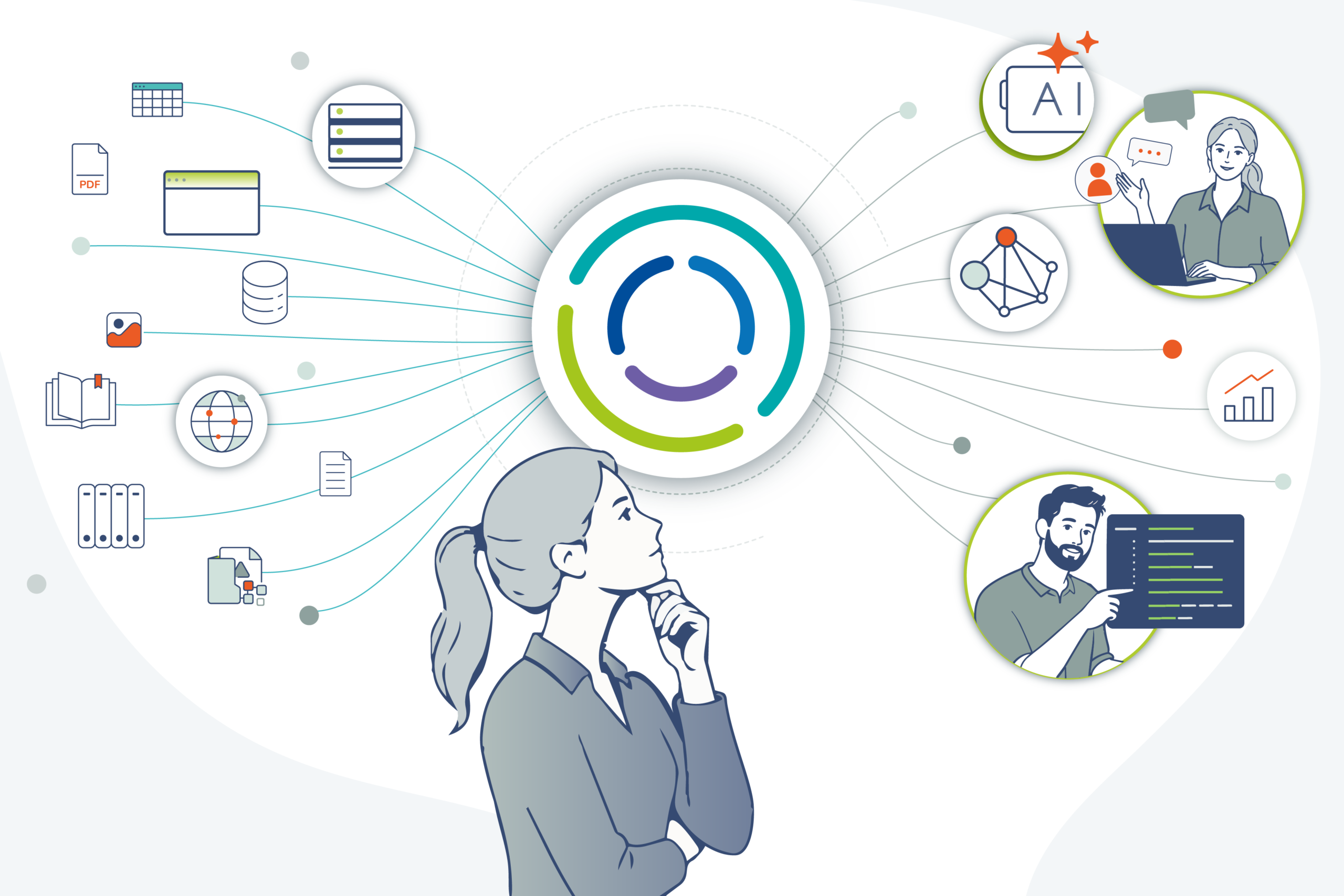
“I think the biggest lesson we’ve learned from all these years in technical communication is that there’s a virtually endless array of ways companies organize and structure their data,” says Max Gärber, summarizing his experience. “Our job is to connect existing—and sometimes rigid—systems with one another. To achieve this, the core software must be as flexible as possible.” And that’s PANTOPIX SPHERE. The knowledge platform is broadly designed and can support a wide range of use cases, from data enrichment and data integration to data governance, content orchestration, and delivery across a variety of channels or to downstream AI applications.
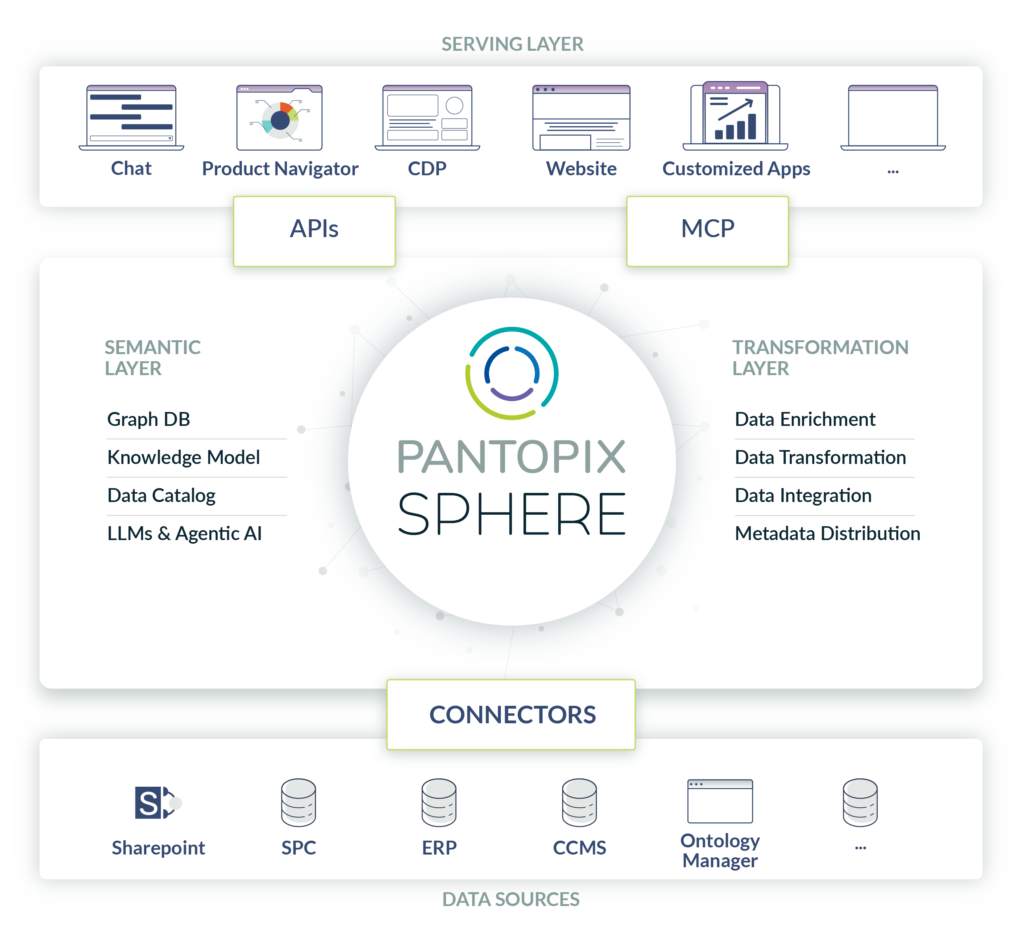
The reason for this is its interface architecture, which is based on established concepts. It supports the Model Context Protocol (MCP) and all common APIs. A key feature is the preconfigured connectors that link the PANTOPIX SPHERE knowledge base with other systems. The platform already includes such standardized interfaces for numerous systems, including connectors for various cloud storage solutions, NoSQL, SQL, and graph databases, ontology managers, content delivery portals, and content management systems.
In this way, PANTOPIX SPHERE bridges the gap between various data sources and an equally broad range of possible output channels. “The architecture of PANTOPIX SPHERE is designed to be so flexible that we can very quickly use extensions—for example, to the connectors—to cover new use cases that we may not have even considered before.”
Our solution is a platform for the semantic integration of all information related to the lifecycle of a technical product. It was particularly important to us to design PANTOPIX SPHERE as a highly flexible platform that connects these various information domains and creates a shared semantic knowledge base from them.
Maximilian Gärber, Partner & Technical Consultant, PANTOPIX
How PANTOPIX SPHERE Works
The Knowledge Graph at the Heart of the Knowledge Base
“The goal is always to build a semantic layer,” says Max Gärber, describing the fundamental approach of PANTOPIX SPHERE. The platform connects technical product information across existing system boundaries and consolidates it into a shared knowledge base. In doing so, information is not simply transferred from one system to another, but is placed in a domain-specific context, and its meaning and relationships to other data are mapped out.
At the heart of the system is a knowledge graph. It forms the interconnected knowledge base in which information from various sources is brought together in a structured manner. This is based on a comprehensive data model consisting of ontologies and taxonomies. These define which business objects exist, how they are related, and which categories are relevant to them. “The ontology is something like a navigation system or a map,” explains Max Gärber. It not only maps general relationships but, in particular, a company’s individual perspective on its products, information, and processes.
However, that doesn’t mean everything happens automatically, as if by magic. Even though PANTOPIX SPHERE inherently provides everything needed for this, the platform isn’t designed to automatically generate an ontology or a knowledge graph from just any dataset. That’s one of the biggest misconceptions he encounters regarding the product, says Gärber. “Of course, our platform could do that, but just because something is theoretically possible doesn’t mean it’s a good idea. The result would be a generic view of things—exactly the opposite of what we want to achieve. We’re focused on the 20 percent that makes all the difference.” What this refers to is the knowledge that uniquely defines a company and cannot simply be derived generically. The company-specific terms, relationships, and processes must therefore be deliberately modeled in an ontology and linked to the relevant information.
From the source system to actionable knowledge: Data flows
The data flow in PANTOPIX SPHERE begins with a company’s existing information sources. These can include structured data from databases and line-of-business systems, unstructured content from documents, or centrally maintained metadata, ontologies, and taxonomies. “Essentially, it’s about completeness—that is, comprehensive coverage of all types of information,” explains Max Gärber.
Depending on the type of information, different components of PANTOPIX SPHERE handle data onboarding. metaSelect distributes and synchronizes metadata and taxonomies across systems. dataEnrich processes unstructured content and can, for example, classify it, extract relevant entities, and semantically enrich it. dataFlow handles the integration and transformation of structured data. “Based on the user interface, one might mistake PANTOPIX SPHERE for a pure ETL tool,” says Max Gärber. “But nothing could be further from the truth. The platform simply needs these functionalities to move data and use it to create the central knowledge base.”
To create this knowledge base, the information is then organized into the shared data model. Ontology and taxonomy provide the domain-specific framework, while AI and defined rules support the classification and processing of data. The resulting entities, facts, and relationships are represented in a structured manner within the knowledge graph. This makes the relationships between pieces of information explicit, allowing information to be processed in a semantically consistent manner across system boundaries and used in its respective context.
However, the data flow does not end with the Knowledge Graph. Rather, the knowledge base serves as the starting point for various applications. Information can be made available for dashboards or other systems, accessed by machines and applications via APIs, or utilized in human-AI dialogue with the help of chatAssist. “End users can primarily clarify technical information and issues via chat with the Knowledge Graph,” explains Max Gärber. “Power users, on the other hand, can integrate new systems and define how information flows into and out of the knowledge base. Machines can trigger data flows or retrieve specially prepared information packages via the PANTOPIX SPHERE APIs.”
The Knowledge Platform is therefore not a siloed data repository. Information can also flow back into existing systems. “For our client Vestas, for example, we used PANTOPIX SPHERE for a task like this. Tens of thousands of documents were analyzed to categorize them using AI and tag them with metadata. We didn’t alter the original data, but we fed the new information back from the knowledge graph and used it to update the source data.”
We neither feed language models data in isolation nor, as in the classic RAG approach, simply provide relevant content as additional context. With GraphRAG, we give the LLM access to semantically linked knowledge—that is, to information, its meaning, its relationships to other information, and the company-specific context in which it is embedded.
Maximilian Gärber, Partner & Technical Consultant, PANTOPIX
Making knowledge available in a controlled and traceable manner
“For me, two things are crucial in an enterprise-ready knowledge platform: First, there must be clear rules governing who is allowed to access which information. Second, I must be able to trace at any time where information comes from and what has happened to it,” says Max Gärber, explaining two important governance requirements.
PANTOPIX SPHERE therefore maps a company’s organizational and authorization structures. Role-based access control (RBAC) allows you to control which information is available to which users or user groups. After all, not all information is intended for every employee, every department, or every application.
It is possible to trace the origin of information and the path it took through the platform at any time, because “data lineage” documents the origin and processing chain of the data. This makes it possible, for example, to determine from which source system information was imported, how and by whom it was processed, and where it was subsequently made available again.
“The more we connect knowledge from different sources and make it available to people, systems, and AI, the more important data governance becomes. That is why this level of control is also an integral part of PANTOPIX SPHERE.”
Who is PANTOPIX SPHERE the right solution for?
PANTOPIX SPHERE is a highly flexible enterprise knowledge platform with numerous use cases related to product knowledge. “But it’s not a panacea for every company with a data problem,” says Max Gärber. “Of course, there’s a certain amount of effort involved in creating and aligning the concepts and relationships that are to be modeled. I think the question should rather be where the use of PANTOPIX SPHERE makes sense.” And that’s exactly where it makes sense—in companies that work with complex or highly configurable products and want to harness lasting knowledge about products, structures, and relationships.
The platform is therefore particularly geared toward the manufacturing sector and industry. This includes sectors such as mechanical and plant engineering, medical technology, and aerospace. Less of a focus is placed on very simple product portfolios or data that is constantly changing, such as motion, logistics, or sensor data. “Our goal is not to create a platform for as many real-time data transactions as possible, but rather a robust knowledge base for product information that remains relevant over the long term,” summarizes Max Gärber. “However, a company’s ability to describe its business objects, processes, and relevant relationships is also a prerequisite for using PANTOPIX SPHERE.”
Outlook: The Future of PANTOPIX SPHERE
The PANTOPIX SPHERE knowledge platform available today is virtually indistinguishable from the original vision. Only a portion of the development remains to be completed, and this part is just as ambitious as the rest of the product. “At the moment, the flows—that is, the data flows—are configured via a standard user interface. What’s still missing is the ability to do this using natural language. If someone can describe the flow, then PANTOPIX SPHERE should be able to execute it,” says Max Gärber, describing the component that is still missing. This development is so innovative that PANTOPIX has received a research grant from the Federal Ministry of Research, Technology, and Space.
The Evolution of PANTOPIX SPHERE
Long before the product was developed, PANTOPIX was grappling with the same challenge: connecting different systems and incompatible data structures. This integration problem forms the starting point for the platform.
2015–2018
Making Metadata Usable Across System Boundaries
The earliest stage of development was a tool that would later become the metaSelect app. In a project at ZEISS, centrally maintained taxonomies and metadata were specifically distributed to technical writing and content delivery systems. This made it possible to re-establish relationships between content from different systems using shared metadata.
Data Integration and Migration
These projects made it clear that virtually no comprehensive information solution can function without data migration, transformation, and integration. This led to the development of dataFlow as another building block of the future platform.
Starting in 2022
LLMs Become the “Aha” Moment
The new capabilities of large language models fundamentally changed the possibilities. Unstructured documents could suddenly be processed, classified, and indexed with reasonable effort. This led to the creation of dataEnrich and chatAssist. With that, the concept behind PANTOPIX SPHERE was essentially complete: rule-based and semantic processing could be combined with the strengths of LLMs.
2023
From Components to a Platform
The decisive step toward today’s Knowledge Platform came with the Knowledge Graph as its central building block. “From that point on, it was clear that we didn’t just have individual tools that did something, but a system that stores information and changes and grows,” says Max Gärber, describing this stage of development.
Today
Flexible Data Integration Meets Semantic AI
Today, PANTOPIX SPHERE brings together the various strands of development into a single platform: integrating and transforming heterogeneous information sources, structuring information semantically, linking it together in a knowledge graph, and making this knowledge base usable for people, systems, and AI. The knowledge graph is an integral part of PANTOPIX SPHERE’s long-term vision.
The Future
Configuring PANTOPIX SPHERE Using Natural Language
The original vision has been largely realized. One remaining development step is to enable more robust language-based interaction with the platform: In the future, users will be able to describe a desired data flow, which the platform will then implement.

Maximilian Gärber
Technical Consultant | PANTOPIX

Sandy Hedig
Marketing Manager | PANTOPIX
We will be happy to inform you regularly about new articles, videos or podcast episodes.

Knowledge
Learn more about connecting information