




Use Cases
Digital Product Passport - meeting requirements and creating added value
From regulatory obligation to strategic advantage: All that is needed to implement the DPP quickly and in a structured manner is the clean networking of existing data.
The digital product passport (DPP) is becoming the new reality for many companies. It requires product information to be transparent, consistent and accessible throughout the entire product life cycle. This brings into focus a topic that many companies have only indirectly addressed to date: the structured and networked organization of product data, content and knowledge.
Initial situation
New requirements due to the digital product passport
The DPP focuses on a question that many companies have only marginally solved so far: How can product information from different systems be merged, structured and linked in such a way that it can be provided consistently and comprehensibly?
For many, the answer to this is an urgent rethink: away from isolated systems and towards a consistent information basis.
The biggest hurdles for the DPP
Data is stored in silos
Lack of consistency
Complex consolidation
Limited scalability
Opportunities
The DPP as an impetus for better information structures
The digital product passport is not just an additional requirement. It makes existing weaknesses in the information architecture visible. At the same time, it offers the opportunity to fundamentally rethink information:
- away from isolated data
- towards networked information structures
- away from individual solutions
- towards scalable, reusable models
Companies that take this step benefit not only from the DPP, but also in many other areas – from service to sales.
4 steps to the DPP
What the digital product passport actually requires
For the digital product passport, information must be brought together that is currently usually stored in different systems, such as the PIM system, the CCMS or a spare parts catalog. In many companies, this is the greatest effort involved in implementing the DPP.
The first step is to define what information is required for the digital product passport. In addition to traditional product data, this also includes technical documentation, information on materials, components and life cycle phases. It is crucial to create a clear understanding of the requirements at an early stage, both from a regulatory perspective and from the company’s own product and data perspective.
The required information is usually distributed across various systems, such as PIM, CCMS, ERP or other data sources. These need to be identified, evaluated and made accessible. The aim is to make the relevant data available across all systems and to create a basis on which information can be merged.
In order for information to be usable in the context of the DPP, it must be clearly structured and linked to one another. Products, components, documentation and other content must be related. This is the only way to create a consistent overall picture that is comprehensible and meets the requirements for transparency and traceability.
The final step is to ensure the quality and timeliness of the data and make it available. Information must be maintained consistently across all systems and be available in a form that can be used for the DPP. Stable, scalable provision is crucial in order to operate the digital product passport efficiently in the long term.
PANTOPIX & Digital Product Passport
How can the digital product passport be implemented efficiently?
The digital product passport is a specific use case, but not the actual goal. The real challenge lies in structuring product data, documentation and other information in such a way that it can be provided consistently.
This is what PANTOPIX specializes in. We network data across systems and build semantic knowledge models that put information into a clear context.
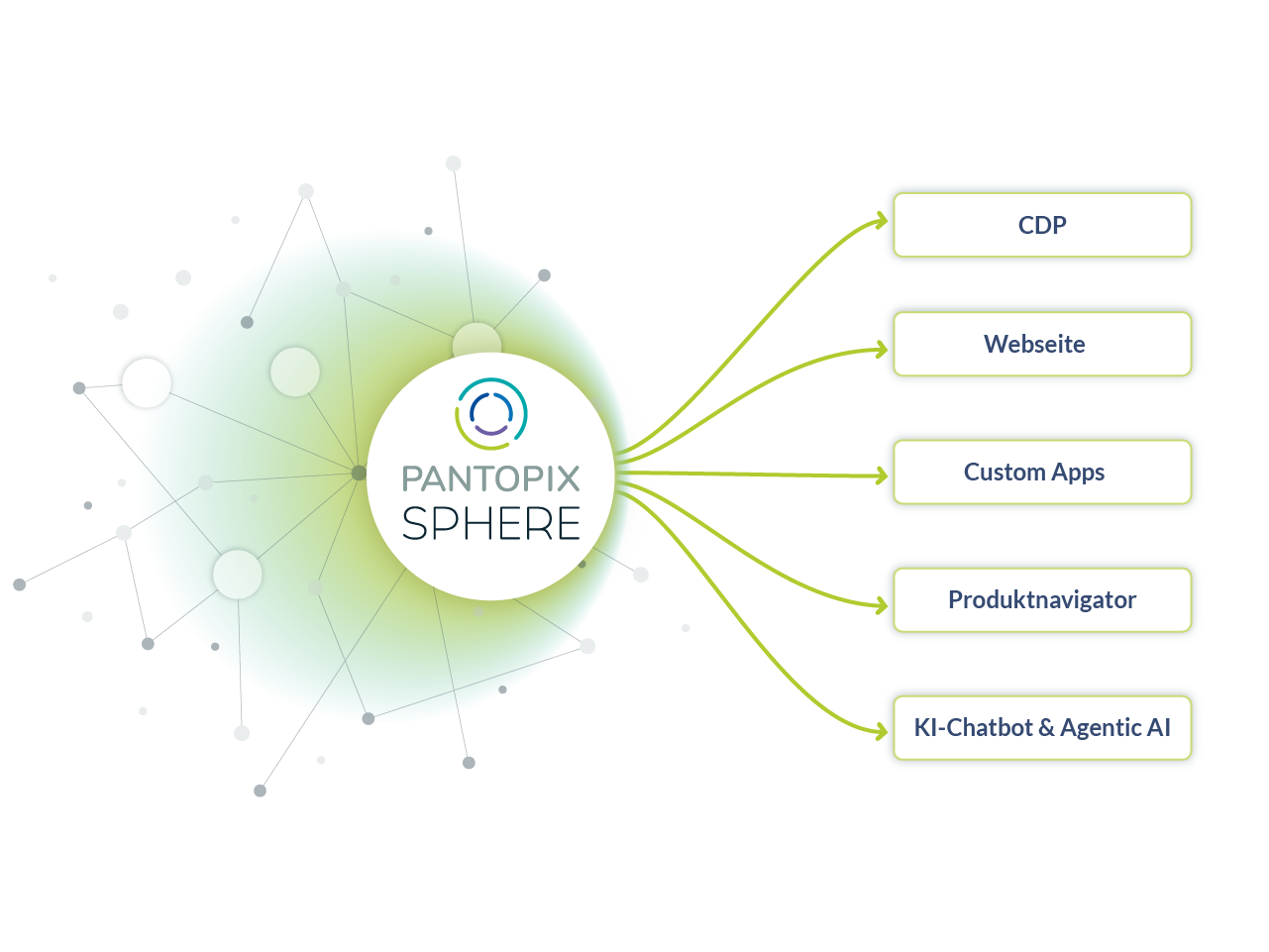
We implement this technically with PANTOPIX SPHERE. The platform combines content from PIM, CCMS, ERP and other systems and transfers it into a networked data model from which the digital product passport can be derived directly.
The key difference is that the data is not prepared for the DPP. The DPP is created from the structure.
This not only benefits companies in terms of meeting regulatory requirements, but also creates a foundation that is effective in other areas, from service and maintenance processes to new digital applications.
"The digital product passport is not an isolated task. It shows how important networked, consistent and structured information has become and is therefore the starting point for better information architectures."

FAQ
Frequently asked questions about the digital product passport
How do companies actually implement the digital product passport?
As a rule, implementation does not begin with the DPP itself, but with the analysis of existing data. Companies need to understand what information already exists, where it is located and how it can be merged. The decisive factor is to structure this data across systems and relate it to one another. This is exactly where approaches such as PANTOPIX come in: The DPP is not built separately, but derived from networked data.
Why do many companies have problems implementing the DPP?
Many approaches fail because the DPP is viewed as an isolated project. Data is often merged manually or new data silos are created. This leads to high maintenance costs and a lack of scalability. Implementation only works sustainably if existing data sources are networked and structured. This is the difference between one-off solutions and a long-term, sustainable approach.
How can existing data silos be broken down for the DPP?
Data silos arise when systems work in isolation and information is not linked to one another. For the DPP, these boundaries must be overcome. This is achieved by logically connecting data rather than physically combining it. Platforms such as PANTOPIX SPHERE make this possible: they link information across system boundaries and create a common semantic basis.
How can the DPP be implemented without additional maintenance work?
Additional maintenance work is required in particular when data is maintained multiple times or compiled manually. An efficient approach relies on existing data sources and continues to use them in a structured manner. Once information has been properly linked and modeled, it can be used automatically for the DPP. In this way, the product passport is created from existing data without parallel data storage or duplicate maintenance.
How does PANTOPIX SPHERE support the implementation of the DPP?
PANTOPIX SPHERE combines data from different systems and transfers it into a semantic knowledge model. This creates a networked database from which the digital product passport can be derived directly. The advantage: information does not have to be maintained twice and remains consistent across all use cases. At the same time, a basis is created that can be used far beyond the DPP.
Your question is not listed?
We are happy to answer all open questions personally and without obligation.