
30. October 2026
Metadata has long been the foundation of modern information management and use. It describes content and thereby helps improve search results, manage variations, and make information assets manageable in the first place. For anyone working in the field of information architecture, it is a key tool for bringing order to growing content, product, and data landscapes.
However, the requirements for information architectures have changed. Even when metadata models and content management systems are in use and information is classified, many companies today still reach a limit. This becomes particularly evident when using new technologies such as AI. For example, chatbots deliver unreliable results because, although they can now access the company’s content via RAG, they do not sufficiently understand its subject-matter context. Or content cannot be delivered with the right context because the relationships between product, variant, function, usage scenario, and target audience are not modeled explicitly enough.
Traditional metadata models work exceptionally well when information is used within a clearly defined context, and metadata itself will continue to serve as an essential foundation. However, as information spaces become more complex and companies expect knowledge to be accessible across channels, across systems, and in a way that is AI-ready, this traditional metadata model will no longer suffice.
Metadata describes content, but does not link it
Traditional metadata was designed for an object-centered information world. It answers important questions such as: What kind of content is this? Which language does it apply to? Which product does it belong to? Which target audience is it intended for? Which version is current? In document- or content-centric environments, this represented a huge improvement over unstructured storage systems, because it allowed a document, a topic, or a data object to be precisely described, categorized, and thus more easily managed. Traditional metadata models can also represent relationships to a certain extent, but they tend to treat them as attributes or system-specific references. As a result, meaning, relationship type, and context often remain implicit.
However, explicit relationship knowledge is extremely important, because users often aren’t looking for isolated content, but rather for an answer within a specific context. A service technician doesn’t want to find just any set of instructions, but rather the specific information about the particular machine she’s standing in front of, the installed component, the error message, the software version, and the action she needs to take right now. A product manager needs not only product data but also the connections between features, variants, markets, standards, documentation, and service cases. And for AI, these relationships must be even clearer. While humans can quickly grasp even implicit connections and rules, AI can only simulate this understanding. For AI to understand context, it must be explicitly defined.
Let’s take a seemingly simple attribute like “Industry.” What does this field mean? The customer’s industry? A product’s target market? The industry to which a marketing asset is relevant? Or the organizational classification within a company? For a human, this meaning can often be inferred from the respective system or interface. For an AI, however, it is by no means self-evident.
Information architecture is therefore evolving from the description and organization of individual information objects toward a more explicit modeling of their relationships and semantic connections. This shift also changes the central focus of this professional field. Today, the goal is to model knowledge spaces in such a way that relationships become machine-readable, verifiable, and usable by applications. Knowledge graphs are one tool for achieving this.
Knowledge graphs make information architecture practical
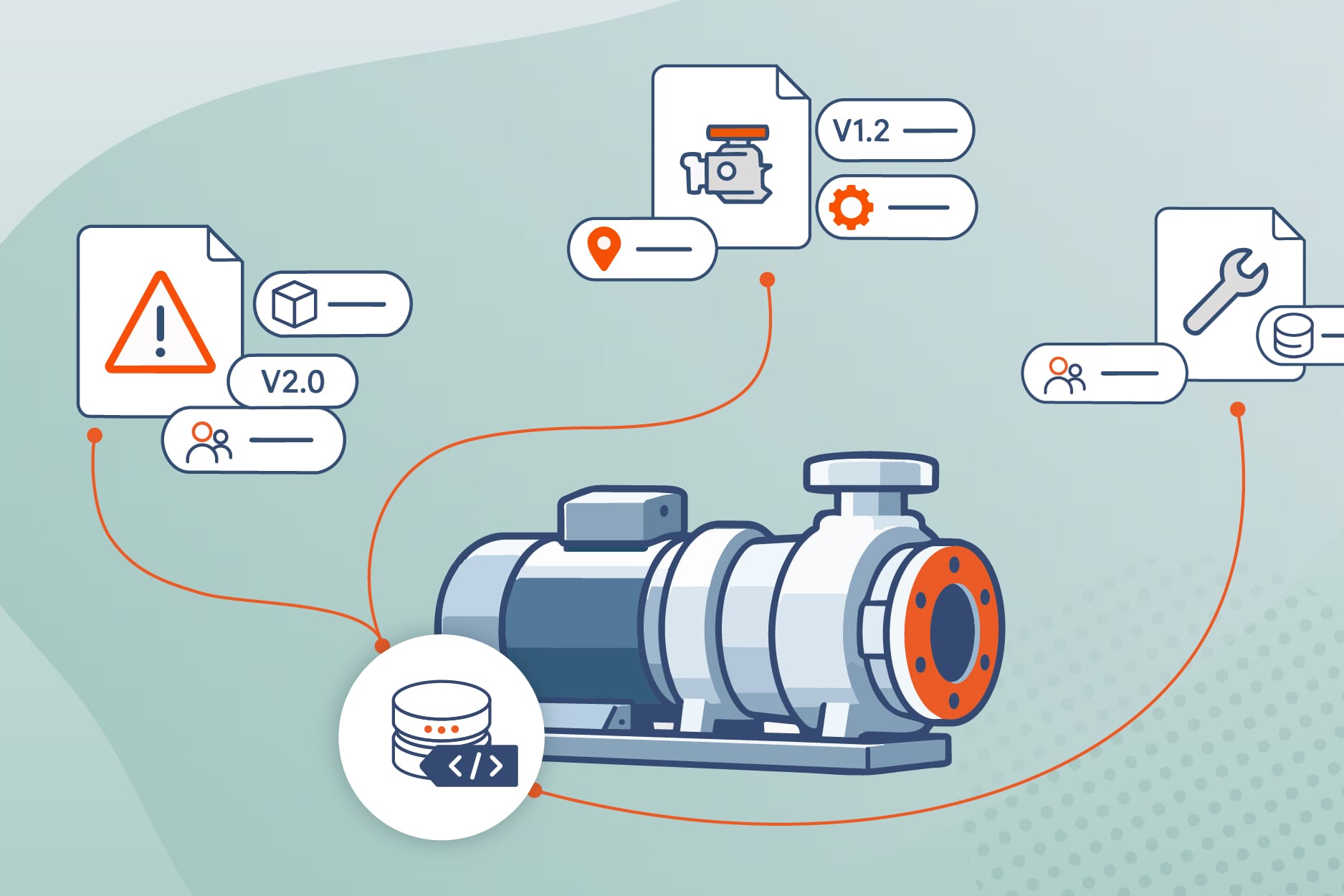
A knowledge graph connects information as a network of objects and relationships. It describes not only that a piece of content has certain properties, but also how content, products, components, functions, processes, roles, markets, standards, and usage scenarios are interrelated. For example, a knowledge graph can reveal that a specific content module is not simply part of Product A, but is relevant to a specific product variant, a particular firmware version, a defined target audience, and a specific process step.
This is particularly important for information architects because a knowledge graph does not replace existing structuring work. It builds upon it. Taxonomies, ontologies, controlled vocabularies, metadata models, and modular content structures do not become obsolete. They are placed in a broader context and made more usable for specific applications.
This usability is evident wherever content is no longer merely stored but is intended to be intelligently delivered—such as in semantic search, content delivery portals, AI-based assistance systems, self-service offerings, or technical support processes. In short: in all systems that must make context-dependent decisions about which information is relevant, valid, and trustworthy.
AI Exacerbates the Weaknesses of Shallow Information Models
As previously mentioned, the current debate surrounding AI highlights the limitations of traditional metadata models. Many companies want to use their existing content for chatbots, search assistants, or generative AI applications. In practice, however, they quickly realize that their large document repository is far from being a good knowledge base. AI responses are sometimes technically vague, and sometimes even completely wrong. These “hallucinations” (answers invented by AI) also pose a major risk because the responses usually sound very convincing linguistically. Even when they have access to corporate knowledge, non-symbolic AIs such as Large Language Models (LLMs) answer questions based on probabilities. You could also say they’re simply guessing. The most probable answer wins.
Knowledge graphs can play an important role here in improving the quality of answers and preventing hallucinations. They provide AI applications with a structured, domain-specific context, thereby enabling the contextualized use of information. AI then does not have to rely solely on text fragments to determine what belongs together; instead, it can access an explicit network of relationships.
This gives information architects a new strategic role. Their work is essential to ensuring that AI in the enterprise doesn’t just produce impressive demos, but can actually deliver reliable results. Good prompts and powerful models are useless if the knowledge base behind them isn’t sufficiently structured.
Designing Knowledge Spaces as a New Perspective
That doesn’t mean every organization needs a comprehensive enterprise knowledge graph right away. A more sensible starting point is often a specific information domain where the limitations of current metadata models are clearly evident: technical documentation, service knowledge, product information, support cases, spare parts information, or regulatory content such as the digital product passport.
Information architects play a role here that goes far beyond organization and classification. They shape the conditions under which corporate knowledge becomes usable. They help determine whether content is merely managed or can be integrated into digital processes, AI systems, and service offerings. Metadata remains an important building block for this, but it is no longer sufficient on its own. The goal is an information space in which knowledge is not only described but also interconnected.

Sandy Hedig
Marketing Manager | PANTOPIX
We will be happy to inform you regularly about new articles, videos or podcast episodes.

Knowledge
Learn more about connecting information