From Content Silos to Knowledge Architecture: How CCMS and Knowledge Graphs Enable Scalable Digital Systems

18. May 2026
Digital transformation requires a new information architecture
Today, the greatest challenge of digital transformation lies in the ability to strategically manage complex system landscapes, rather than in the adoption of individual technologies. For leaders tasked with developing digital business strategies and driving digital transformation within their organizations, this means that simply implementing new tools is no longer enough. What matters most is creating an architecture that enables scalability, reduces complexity, and accelerates innovation.
This presents a problem that is often underestimated: While companies are investing heavily in data platforms, AI, and automation, the content layer remains structurally fragmented. Information is stored in silos, is redundant, inconsistent, or lacks context. As a result, integrations become costly, automation remains limited, and AI initiatives fail to scale.
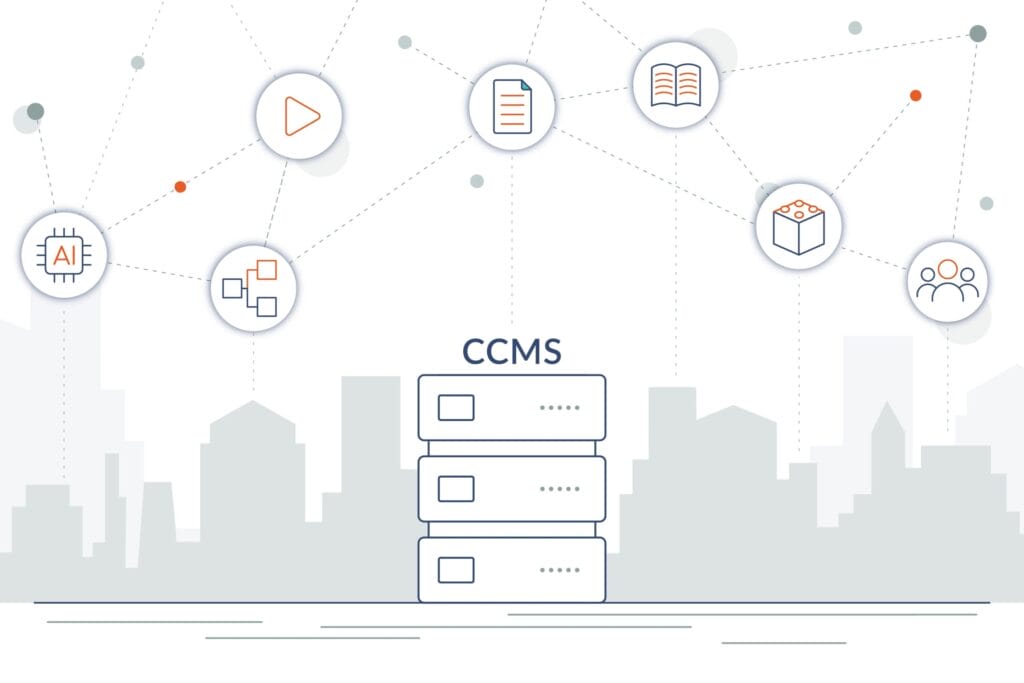
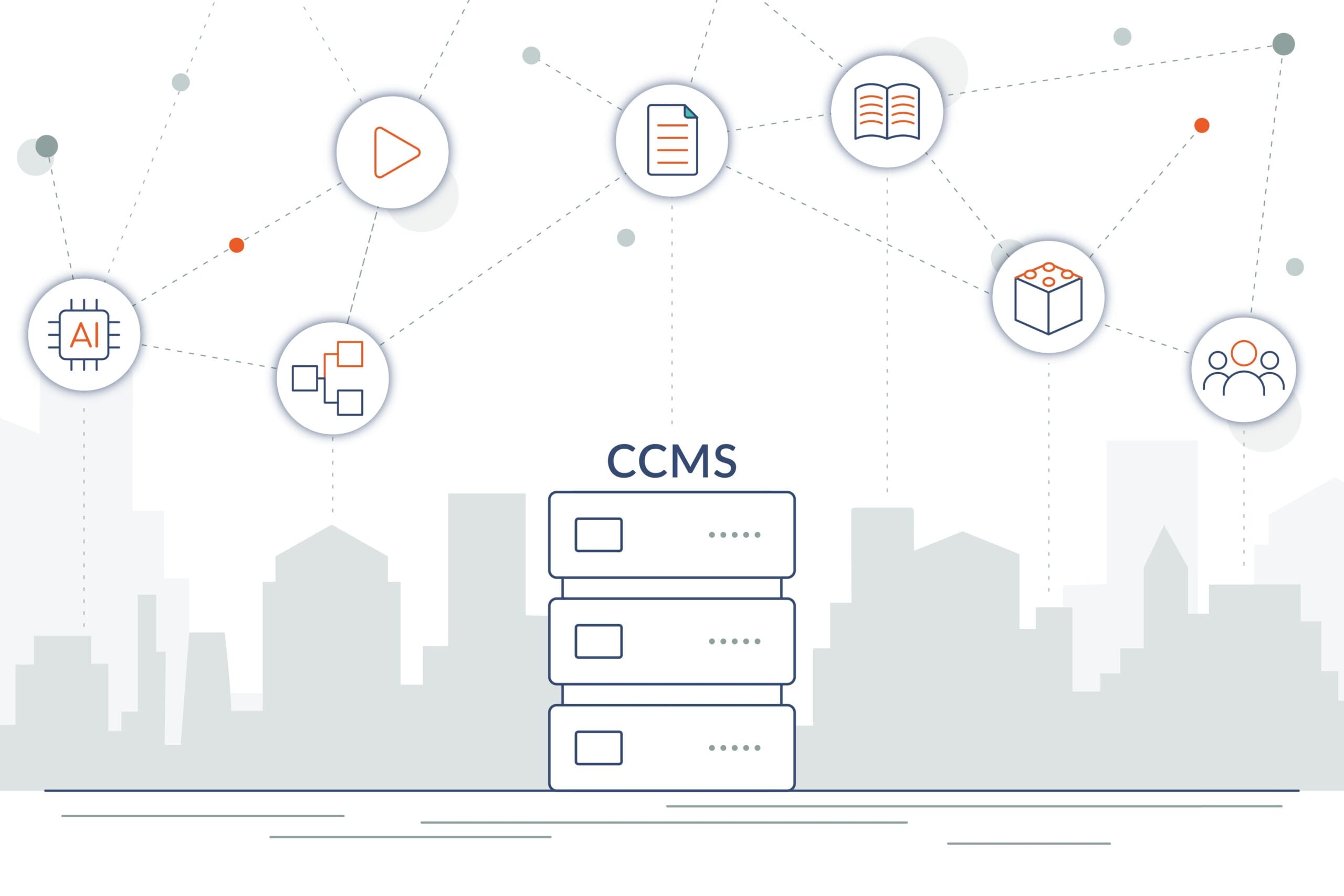
A Component Content Management System (CCMS) can play a key role here, but only if it is viewed not as a content management system, but as a building block of an overarching information architecture.
Why Traditional Content Management Systems Hinder the Scaling of AI and Automation
Organically grown IT landscapes rarely follow a clear logic. Over the years, systems have been added, integrated, or replaced without resulting in a consistent information structure. Content is particularly affected by this: it is tightly tied to specific applications, difficult to reuse, and rarely usable across different systems.
When implementing digitalization strategies, this gives rise to a structural conflict of objectives. On the one hand, new digital services need to be developed quickly; on the other hand, integration efforts and dependencies are growing exponentially. This becomes particularly clear in the context of AI: without consistent, structured, and contextualized content, many use cases remain experimental.
The real challenge, therefore, is less technological than structural. There is a lack of a scalable framework for handling information.
CCMS as the foundation for scalable content and system architectures
A CCMS addresses this issue by modularizing and structuring content. Instead of working in a document-centric manner, content is broken down into reusable building blocks, regardless of format, channel, or application.
For businesses, this represents a fundamental shift in perspective. Content is no longer viewed as a static end product, but rather as a dynamic resource that can be flexibly deployed in various contexts. This decoupling is crucial for modern system architectures, as it simplifies integrations and increases reusability.
But as necessary as this structure is, it is not enough on its own.
CCMS and the Knowledge Graph: The Crucial Step Toward a Connected Knowledge Base
The real added value comes from combining the CCMS and the Knowledge Graph. While the CCMS provides structure, the Knowledge Graph creates context. It maps relationships between content, products, variants, processes, and target audiences, making them machine-readable. This results in a new level of information quality: content is not only available but also interpretable. Dependencies become visible, connections are made explicit, and data becomes interoperable across systems.
A look at how this approach is being implemented in practice at one of our clients illustrates its concrete impact: At a global industrial company, an existing content management system that had outgrown its capacity was replaced with a CCMS, and the company systematically transitioned to a modular content structure. At the same time, a knowledge graph was established to link content from the CCMS with product data from the PIM system.
The key difference lay not in the introduction of a new system, but in the resulting integration: for the first time, content, products, variants, and target groups were mapped within a single, unified model. This created a seamless flow of information, from product definition through technical documentation to use in service, sales, and digital applications.
For the company, this meant not only more efficient editorial processes, but above all a new level of system integration. Changes to product data could be reflected directly in the documentation and downstream channels, while content was simultaneously delivered in a context-sensitive and automated manner.
CCMS Integration as an Enabler for AI, Automation, and Digital Business Models
The strategic importance of a networked CCMS is particularly evident in the context of AI and automation. After all, these technologies are only as effective as the data and information on which they are based.
A CCMS combined with a knowledge graph lays the groundwork for this. Content is structured, semantically enriched, and contextualized. This not only enables better search and assistance systems but also the automation of complex processes.
In addition, new opportunities are emerging for digital business models. Content can be used across channels, delivered dynamically, and integrated into digital services. Technical documentation thus transforms from a cost center into a value driver.
Governance and Architecture: Why CCMS Projects Must Be Approached Strategically
Implementing a CCMS is more than just a traditional IT project. It lays the foundation for a consistent information architecture and thus impacts core processes and structures. This is a key factor: in addition to the technical implementation, the goal is to design the content and semantic foundation in such a way that systems can be scaled and integrated over the long term.
How is the information architecture defined? What semantic models are used? How is content maintained and further developed over the long term? And how is it ensured that the solution scales to meet growing demands?
In practice, this often creates a tension: projects are expected to deliver results quickly, yet the underlying architecture must be designed to remain scalable in the long term. Standards such as DITA can help establish structure, but they do not eliminate the need for well-thought-out semantic modeling.
Conclusion: CCMS and the Knowledge Graph as Strategic Infrastructure for the Digital Future
For companies seriously committed to driving their digital transformation, choosing the right information architecture is a critical decision. A CCMS is a central component of a scalable information architecture. When combined with a knowledge graph, it becomes a fully interconnected infrastructure that can be used across systems, reducing complexity, making systems more flexible, and laying the groundwork for AI, automation, and new business models.
For those responsible for digital transformation, this means a shift in perspective: moving away from isolated system decisions toward the development of an interconnected and scalable knowledge system as the foundation for modern digital value creation.
However, the structural and semantic interlinking of information merely lays the groundwork. Equally crucial is the question of how content can be made available in a flexible, context-sensitive, and cross-system manner. This is where the next stage of development for modern information architectures lies: linking structured content from the CCMS with semantic relationships from the knowledge graph in such a way that content, product data, and contextual information are consolidated across systems and become automatically usable.
Approaches such as PANTOPIX SPHERE demonstrate how these can be used to develop end-to-end, scalable knowledge architectures that not only manage information but can also flexibly make it available for digital processes, AI applications, and various usage contexts. In a future article, we will examine the role that content delivery portals play in this context and how such architectures can be implemented operationally.

Sandy Hedig
Marketing Manager | PANTOPIX
We will be happy to inform you regularly about new articles, videos or podcast episodes.

Knowledge
Learn more about connecting information