
12. March 2026
Companies today have more data than ever before and therefore have enormous potential. Used correctly, data enables better decisions, reduces blind spots and makes complex relationships visible. It can increase efficiency, identify customer needs more precisely and strengthen competitiveness.
In practice, however, the opposite is often the case. Many companies get lost in heterogeneous data landscapes. Valuable information remains unused because it is hidden in data silos or its quality leaves something to be desired. More data does not automatically mean more knowledge. Distorted, outdated or misinterpreted information can even make decisions worse.

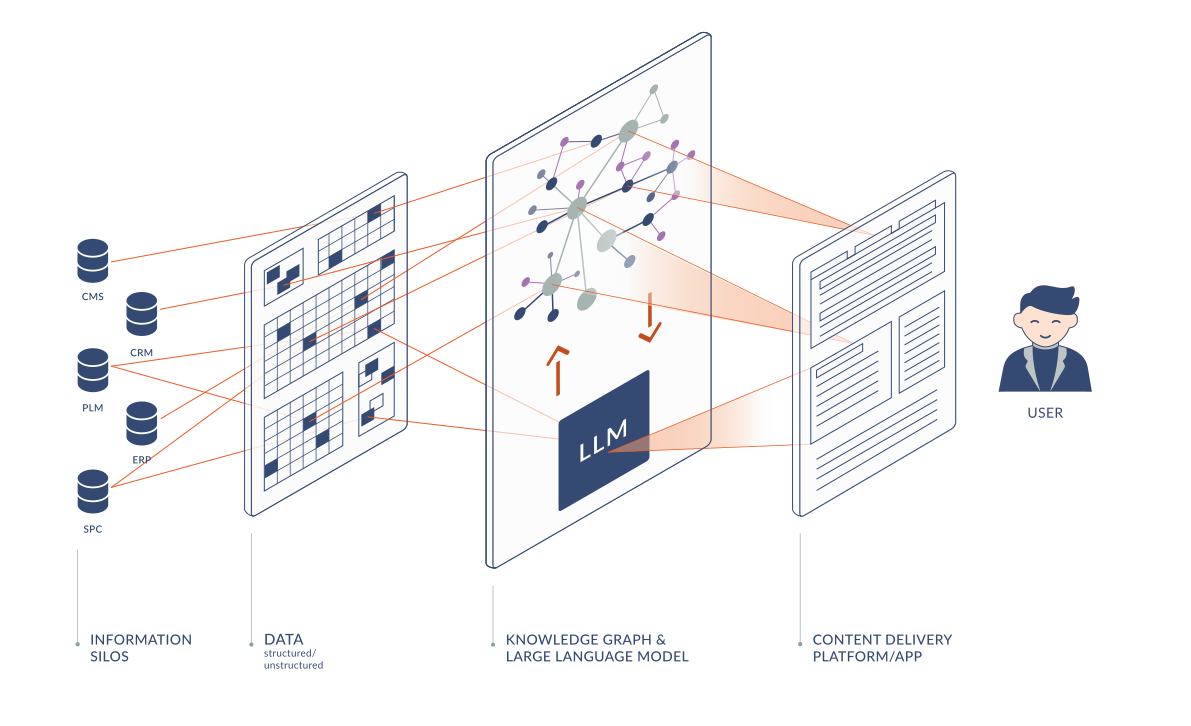
This is precisely where knowledge engineering comes in. It is a central component of modern knowledge management and uses artificial intelligence methods to transform data into structured, networked knowledge. This goes far beyond pure data storage. Semantic models, intelligent search and AI-supported knowledge processing create context, enable machine understanding and ensure transparency.
Knowledge Engineer Dr. Amir Laadhar explains how companies can use knowledge modelling to identify correlations, harness knowledge and make more informed strategic decisions.
The challenges of modern corporate data landscapes
Many companies have huge amounts of data stored in different systems, from traditional databases to ERP and CRM systems to unstructured documents and emails. This fragmentation means that information often remains isolated, is difficult to find and can only be used to a limited extent.
Dr. Amir Laadhar emphasizes that the problem is not only of a technical nature. “Companies often have valuable knowledge that is not networked and therefore cannot be accessed in context,” he explains. The consequences are inefficient processes, repetitive work and a limited decision-making basis for strategic measures.
In addition, traditional search and analysis tools are increasingly reaching their limits. Information is often unstructured, semantic correlations remain hidden and the amount of data is growing faster than it can be processed manually. Without an overarching approach such as knowledge management and knowledge engineering, knowledge gaps arise that impair innovation and competitiveness.
Technologies in knowledge engineering: knowledge graphs, ontologies and AI
“Above all, knowledge engineering means modeling knowledge with the help of artificial intelligence methods and tools. It’s not just about storing data, but about systematically capturing and structuring knowledge and making it usable for companies,” explains Dr. Amir Laadhar. “In this way, relevant concepts, their relationships and rules are mapped in order to make connections visible and improve processes. This is the basis for modern knowledge management.”
To ensure that knowledge does not remain fragmented but can be used systematically, knowledge engineering makes use of a number of key technologies.
Knowledge graphs are structures that represent information as nodes and relationships and thus make connections visible. They enable context-related queries, conclusions and flexible extensions, even with very heterogeneous data sources.
Ontologies are definitions of terms and their relationships in order to organize knowledge in a consistent and machine-understandable way. They create a common language across systems and departments and form the backbone of knowledge engineering, so to speak. To ensure that such structures are maintained consistently over the long term and remain usable across different systems, systematic metadata management is required.
Semantic data integration creates links between data from different sources so that they can be used in a coherent way.
AI integration enables the use of artificial intelligence, e.g. large language models, for the automated processing, contextualization and analysis of knowledge.
Knowledge platforms bundle these technologies and make them usable in practice. Intelligent solutions such as PANTOPIX SPHERE support companies in connecting existing data and systems to create an information world and thus use your information for specific applications.
“This is only a small part of the methods that we Knowledge Engineers use in our work,” explains Dr. Laadhar. “But they are essential. We use them not only to make information accessible, but also to ensure that applications such as intelligent search, AI-based Q&A systems or decision support function reliably. Knowledge engineering is thus transforming the way companies deal with knowledge.”
Knowledge engineering in practice: use cases for companies
Knowledge engineering is particularly valuable in concrete applications that bring direct benefits to companies. Dr. Amir Laadhar explains: “The theory is important, but it is only in practice that it becomes clear how this work improves processes and makes knowledge truly accessible.”
Here are a few examples:
Product data management (PIM)
“The requirements for PIM systems have changed considerably,” Dr. Laadhar points out. Nowadays, it is no longer just about the central management of product data. Complex product structures must be displayed, different types of information integrated and made available depending on the context.
Traditional, purely data-based approaches in product data management can only fulfill this to a limited extent. The work of Knowledge Engineers offers suitable solutions for this. “By connecting to a knowledge graph, product information is not only stored, but also put in relation to each other. Products, variants, components, documents, media, target markets and applications are semantically related.”
We have already described how a PIM system based on knowledge graphs works in another article.
Technical documentation
Traditional approaches are also increasingly reaching their limits in technical documentation. Products are becoming more complex, variants more numerous and regulatory requirements stricter. However, documentation must be consistent, up-to-date and available for different target groups. According to Dr. Laadhar, this is a key area of potential for knowledge engineering. “With knowledge-based models, content can be structured modularly and linked semantically. Individual information modules know which product, which variant and which usage context they belong to.”
Changes to a component or regulation can thus be automatically taken into account at all relevant points. This reduces redundancies, lowers error rates and significantly speeds up the creation and maintenance of technical documentation.
Technical documentation and knowledge graphs are an exciting combination that we have already explored in a presentation.
Service and support
In service and support, knowledge often determines the speed and quality of the solution. At the same time, this knowledge is often spread across ticket systems, manuals, training documents and the heads of experienced employees. Knowledge engineering helps to bring this fragmented knowledge together and make it usable. “A knowledge graph can link error patterns, causes, affected components, solutions and empirical values,” explains Dr. Laadhar. “This provides service employees with contextualized answers instead of isolated information. AI-supported assistance systems also benefit from this, as they are based on a sound knowledge base.” The result is shorter processing times, more consistent answers and a noticeably better customer experience.
There are also numerous other fields of application that benefit greatly from knowledge engineering. From risk management, which would be simplified by the automatic checking of guidelines and regulations, to marketing, where automated analyses of customer feedback and market information contribute to the data-driven optimization of strategies.
These examples show that knowledge engineering as the methodological foundation of effective knowledge management goes far beyond IT applications and delivers strategic advantages in many different areas of a company. It makes knowledge visible, usable and measurable, making it a decisive factor for innovation and competitiveness.
What changes knowledge modeling triggers in the company
If companies want to focus more strongly on sustainable knowledge management, roles and tasks naturally change, but proven structures usually remain in place, according to Dr. Laadhar. “In our day-to-day project work, it is very clear that external knowledge engineers complement existing teams quickly and easily. They work closely with the specialist departments and contribute knowledge to the systems in a structured way.”
The topic of data quality is gaining attention. “Even basic measures such as clear terminology, linked information and standardized documentation ensure that knowledge systems can be used directly and decisions are supported.”
Collaboration becomes more efficient because knowledge is available across departments. “The aim is to gradually reduce data silos without having to restructure teams.” Employees benefit immediately from more accessible knowledge, learn correlations more quickly and can contribute their expertise in a targeted manner.
Why knowledge engineering is key to modern knowledge management
“Knowledge engineering is a pragmatic introduction to sustainable knowledge management that helps companies to systematically harness knowledge and make better-informed decisions,” summarizes Dr. Laadhar.
Even small, targeted steps bring measurable benefits to companies. Clear goals, a pragmatic approach and the involvement of specialist departments are crucial. It is not technology alone that creates added value, but the combination of knowledge, structure and direct practical relevance. Platforms for intelligent knowledge management such as PANTOPIX SPHERE support this approach by making knowledge engineering accessible in concrete use cases.
“Our project experience has shown that it is helpful to rely on an experienced external partner,” adds Dr. Laadhar. “Methodological expertise, proven process models and sufficient resources ensure that pilot projects are implemented quickly without disrupting existing processes within the company. This allows initial results to be achieved quickly and further developed in a targeted manner.

Sandy Hedig
Marketing Manager | PANTOPIX
We will be happy to inform you regularly about new articles, videos or podcast episodes.

Knowledge
Learn more about connecting information