


28. April 2026
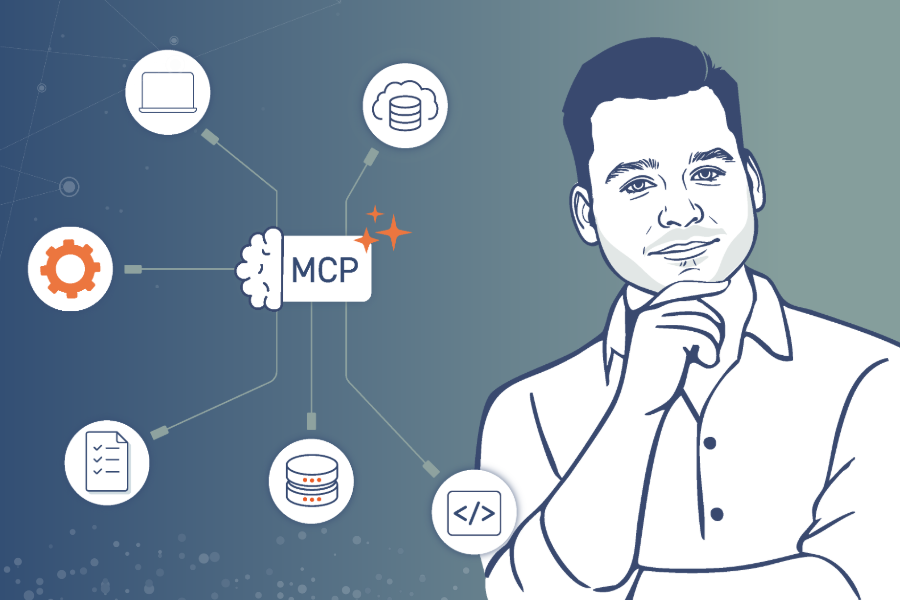
A conversation with our expert Maximilian Gärber about what MCP is all about and the role standards play for AI in enterprise systems.
Anyone currently working with AI will quickly come across the term Model Context Protocol—MCP for short. The standard is designed to make it easier to connect AI models with tools, data sources, and applications. It was introduced in late 2024 by Anthropic (the developer of Claude AI) as the “USB-C for AI.”
At the same time, some developers say that, in the end, it’s just a clean, universal interface. This raises the question: Is MCP a revolution in AI integration, or simply an API with really good marketing?
1. Max, the Model Context Protocol is popping up everywhere these days when it comes to AI. Why is this standard getting so much attention right now?
If you look at the current discussion surrounding MCP, it has less to do with a sudden technical necessity and more to do with classic hype. Influencers, developer communities, and the media are picking up on the topic, thereby creating a certain amount of pressure to deliver. Many are engaging with it because they feel they have to, not necessarily because they actually need it. And then there’s the classic dynamic: first, something gets heavily hyped, and then the backlash follows very quickly. Of course, that attracts even more attention.
In my view, MCP symbolizes a fundamental architectural question: Do we need an additional protocol layer for AI systems, or are direct API integrations and simple tools sufficient? This question is not trivial, which is why it is the subject of intense debate.
2. For anyone hearing this term for the first time: What exactly is the Model Context Protocol?
The Model Context Protocol (MCP) is a standard that defines how AI models—particularly AI agents—interact with external tools, data sources, and systems. Specifically, the goal is to provide a standardized interface through which a model can, for example, retrieve data and perform actions in systems, or receive structured context from various sources. Rather than building a custom integration for each tool, MCP describes how these interactions should be standardized.
3. Why is it difficult to integrate AI systems with tools, data sources, or enterprise software?
The main problem is that systems in companies have often evolved over time and operate in isolation. This means that data is stored in different tools, databases, and applications, and in completely different formats and structures. There is no common “language” and, above all, no shared context.
In addition, these systems are not designed to be used by AI agents. Consequently, they lack interfaces, consistent data models, or clearly defined access logic.
Another issue is semantics. Even if you can technically access data, that doesn’t mean an AI understands it—especially when understanding requires cross-domain knowledge. Information is often not linked, meanings are not explicitly modeled, and context is lost.
That is why integration-only approaches often fall short. A standardized interface—such as MCP—can simplify access, but it does not solve the underlying problem of an inconsistent and disconnected data landscape.
4. What role does MCP play in solving this integration problem?
MCP can be viewed as a structuring layer, meaning it helps bring order to the integration process. Whenever numerous tools, data sources, and systems come together, it offers a way to organize these connections in a more consistent and standardized manner. This can be particularly valuable in larger organizational contexts, as it establishes a common engineering standard, making it easier to leverage existing implementations.
But—and this is the key point—MCP is not a panacea. In many cases, this additional layer is simply unnecessary. Developers often prefer to access APIs directly or use simpler approaches because they are more practical.
5. How exactly could MCP make a difference for businesses?
Essentially, MCP can transform how companies structure and scale their use of AI. Instead of building numerous standalone solutions and custom integrations, MCP creates a unified interface through which AI agents can interact with tools, data, and systems. In theory, this makes it easier for AI to access various sources and integrate them into workflows.
For complex workflows, MCP is helpful because it establishes a common framework for how actions are executed across systems. This can significantly simplify automation. And with AI agents, MCP enables them to work not in isolation but across multiple systems—functioning more like true digital assistants.
The catch, however—and this is evident in practice—is that the benefits depend heavily on how well-structured the knowledge is that the AI accesses.
6. Some say that MCP is a major step forward for AI systems. Others believe it’s basically just a well-defined interface. What’s your take on this?
I believe both extremes are wrong. MCP is neither the major breakthrough that some portray it as, nor is it “just” a trivial interface that can be ignored. What bothers me about the current discussion is precisely this black-and-white thinking. Some people are pinning extreme hopes on it, driven by hype and FOMO. Others respond with an almost reflexive dismissal.
In reality, MCP is a tool with a clear trade-off: it provides additional structure and standardization, which can be useful in certain contexts—especially in larger organizational setups. At the same time, however, it also adds an extra layer of abstraction that is simply unnecessary in many cases.
7. For which companies is it really worth looking into MCP, and for whom is it still irrelevant at this point?
MCP is particularly beneficial for companies that already work with interconnected systems and complex data landscapes—that is, environments where numerous tools, applications, and data sources interact, and integration is becoming increasingly difficult to manage. In such environments, MCP can help establish a unified structure and standardize access for AI agents.
Especially when data is spread across many systems and multiple use cases or automations are to be built on top of it, such a common framework becomes valuable because it reduces complexity and makes integrations easier to manage.
For companies with relatively simple, loosely connected setups or clearly defined use cases, however, MCP is often not yet relevant. In such cases, direct integrations are usually faster, more cost-effective, and sufficient.
8. What role does MCP play for AI agents and automated workflows?
For AI agents, MCP primarily serves to standardize access to structured information and enable the integration of various knowledge sources. It creates a common framework through which agents can consistently access data, tools, and systems, especially in complex environments with multiple sources.
This makes it easier to use information across systems and integrate it into automated workflows, rather than having to build separate integrations for each source.
In my view, however, it is important to note that MCP is not a prerequisite for AI agents or automated workflows. Many scenarios can also be implemented using direct API integrations, and often even more quickly. MCP truly demonstrates its added value, above all, in situations where numerous structured information sources need to be consolidated and orchestrated.
9. If AI is to work with many different systems and data sources in the future, what role will platforms or integration solutions play in this context?
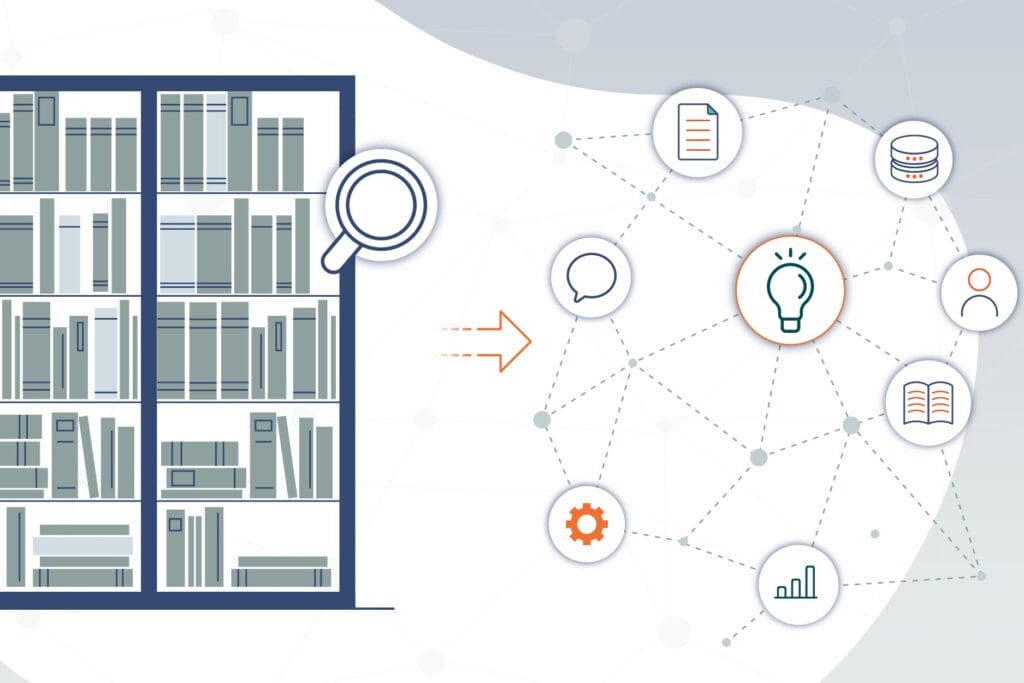
Platforms and integration solutions are absolutely essential in this context. If AI is truly to work with many different systems and data sources, it is not enough to have just one interface like MCP. MCP is a potential building block because it creates a common approach to data access. But that alone is not enough. Companies also need a central architecture that consolidates data, structures it, and places it within a common context. Without this layer, everything remains fragmented, even if the connection works technically.
In practice, there are platform-based approaches that not only provide integrations but, above all, aim to semantically link information from various sources and place it within a shared context. Our own solution, PANTOPIX SPHERE, is an example of this.
The real added value ultimately comes from the applications and use cases built on top of this foundation—namely, intelligent workflows, automation, and AI agents that operate on a solid data and integration foundation.
10. Are there any risks or limitations associated with using MCP?
I see a risk with MCP in the additional overhead: In many cases, it creates another layer of abstraction that makes systems more complex without providing any real added value, whereas direct integrations would often be simpler.
Another concern for me is adoption. If this standard does not gain widespread acceptance, there is a risk of siloed solutions or dependencies that will be difficult to maintain in the long run.
Security and governance are also key issues. As soon as AI accesses various systems via standardized interfaces, the question arises: Who is authorized to do what? How is access controlled, logged, and secured? This is a critical aspect—especially in corporate contexts—that is often underestimated.
And perhaps the most important point: false expectations. MCP is sometimes portrayed as if it were going to solve the fundamental problems surrounding AI integration. It does not. It addresses the interface, but not issues such as data quality, context, or semantic linking.
For me, the biggest risk lies not so much in MCP itself, but in viewing it as a one-size-fits-all solution or using it in the wrong context. MCP can be useful, but only as part of a well-thought-out overall architecture.
Thanks for your feedback, Max!
Conclusion
Even though the Model Context Protocol is currently receiving a lot of attention, it is not a silver bullet for AI integration. Rather, it is one possible building block in a larger architecture that companies use to connect AI systems, data sources, and tools. What remains crucial is how companies structure their knowledge and system landscapes and which platforms they use to orchestrate them effectively.

Maximilian Gärber
Technical Consultant | PANTOPIX
Experience how PANTOPIX SPHERE transforms your information into valuable knowledge.

Knowledge
Learn more about connecting information


We are happy to keep you regularly informed about new articles, videos, or podcast episodes.