
10. October 2025
Semantics is therefore being talked about more and more these days, especially in connection with terms such as “semantic web” or “semantic knowledge management”. But what exactly does semantics mean and how relevant is it for technical documentation?
For many industrial companies, good product communication is becoming an increasing challenge: products and product ranges are becoming more complex. The amount of technical information is growing rapidly. The criteria for the type and provision of content are changing, partly due to customer expectations and partly due to modern technologies such as artificial intelligence. New structures and approaches are needed to efficiently use heterogeneous product information, which is usually scattered in various data silos.
What is semantics?
Semantics play a central role for technical editors, content strategists and information architects if product information is to be structured consistently and processed automatically.
Semantics describes the meaning of information and how this meaning is understood. In linguistics, semantics refers to how words, sentences or expressions convey meaning and how these meanings are interpreted in the respective context.
“A simple example of semantics is the word ‘snake’,” says Dr. Martin Ley, Professor of Information Management at Munich University of Applied Sciences. “At first you probably think of an animal. But if someone says, for example, ‘I’m standing in line’, it means that they are standing in a queue. Semantics therefore helps us to understand the meaning of a word or sentence in a certain context.”
In technical communication, however, semantics is not only about linguistic meaning, but also about the clear structuring of product information.
For this purpose, information is described with metadata and organized in semantic models such as ontologies, taxonomies or thesauri.
Terms such as “pressure valve” or “sensor group” are defined and linked in such a way that their technical function, position and relationship to other components can be clearly understood. This creates semantically structured product information.
Our overview of metadata management in technical communication explains how metadata is systematically modeled, maintained, and made available across different systems.
Our Focus: Semantics for Industrial Information
PANTOPIX focuses on semantics in areas where companies need to clearly structure and link product, service, and technical information. The focus is on how concepts, metadata, and relationships can be modeled in such a way that information can be used consistently across systems and departments.
To this end, we develop information and knowledge models—ranging from metadata concepts and taxonomies to ontologies—thereby laying the foundation for interconnected information systems and intelligent applications.
For more information, see Data Modeling for Interconnected Information.
What is semantic knowledge management?
Semantic knowledge management refers to the use of technologies and methods of semantic analysis and modelling to improve knowledge management in companies and organizations. It is about capturing the meaning and relationships between data and creating a unified view of information, regardless of its source or format.
In semantic knowledge management, semantic models such as ontologies, taxonomies or thesauri are used to describe the meaning of the data and establish relationships between the data. These models can help to integrate data in different formats and from different sources and make it accessible for easier searching and analysis.
This creates a consistent knowledge base that not only makes technical documentation more efficient, but also supports automated processes, semantic searches and analyses, intelligent service applications and digital twins.
“Semantic knowledge management can be of great importance, especially in companies that work with a large amount of unstructured data and information. It enables a better understanding of information and facilitates collaboration between different departments by creating a common language for describing information and a common basis for decision-making,” explains Dr. Martin Ley.
Companies that integrate semantics into their technical communication are laying the foundations for future-proof information systems.
What is the semantic staircase?
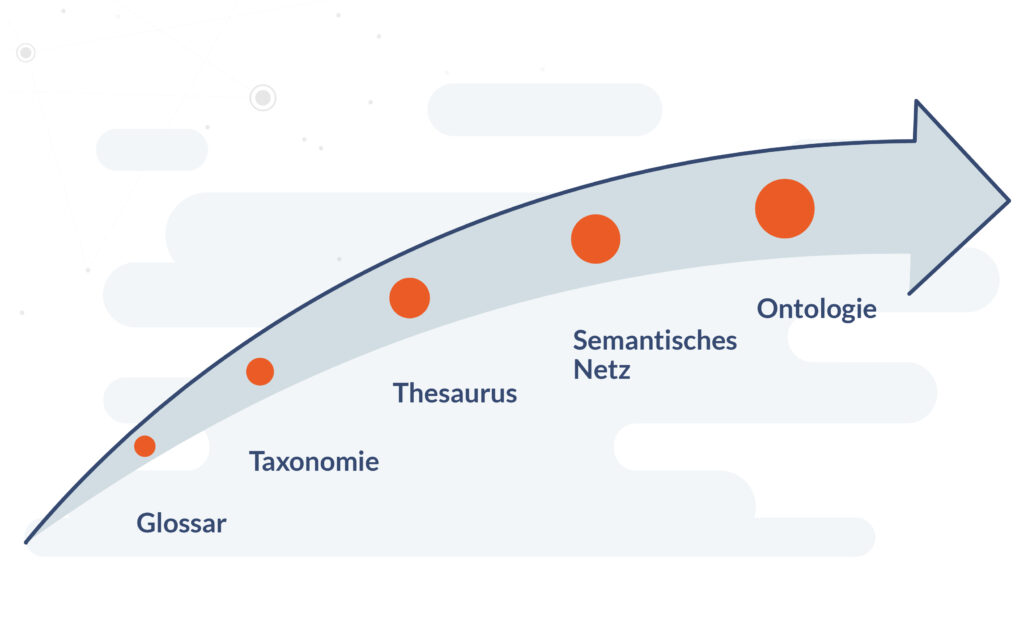
A hierarchical structure is used in technical communication to systematically organize semantic information and display its relationships: the so-called semantic staircase. It visualizes how terms are structured from simple definitions to complex ontologies. The semantic depth increases with each step.
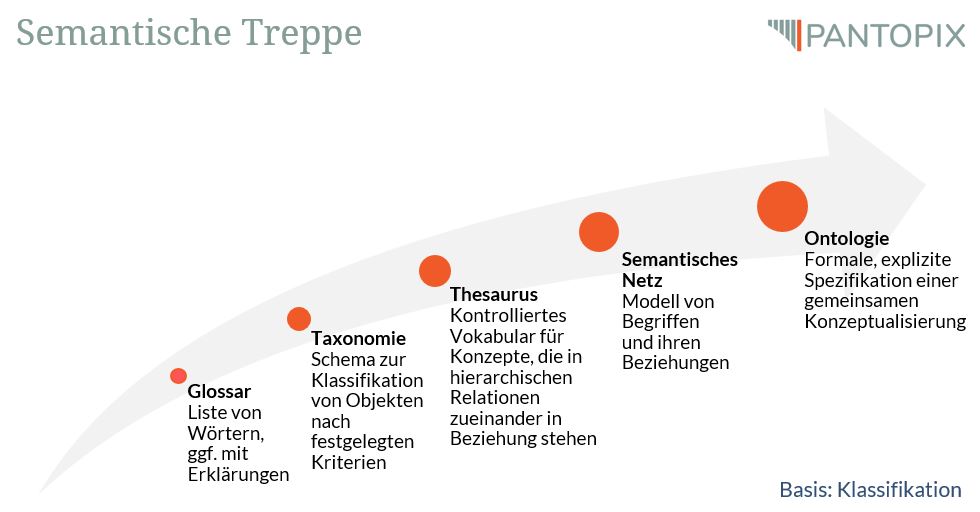
Glossary: A glossary is an alphabetically ordered list of technical terms and definitions used in a particular subject area. It is used to explain the meaning and use of technical terms and to ensure that terms are used consistently.
Taxonomy: A taxonomy is a hierarchical organization of terms into categories or classes to define the relationships between them. Taxonomies are often used to organize and structure information so that it can be found and used more easily.
Thesaurus: A thesaurus is a collection of related words or terms that are organized and categorized. A thesaurus is used to explain the meaning of words and to identify synonyms and other related terms. A thesaurus is often used in information search and processing to improve the precision and relevance of search results.
Semantic network: A semantic network is a graphical representation of concepts and their relationships to each other. It is used to visualize and explain the meaning of concepts and the relationships between them.
Ontology: An ontology is a semantic model that formally defines the meaning of concepts and the relationships between them. An ontology usually comprises a set of concepts, attributes, properties and relationships that are relevant in a particular context.
This knowledge modeling serves to define and describe the meaning of terms and relationships between them in order to create uniform views of information.
Knowledge graphs as a practical application of semantics
Knowledge graphs are a concrete way of making semantic models such as ontologies or thesauri technically usable. They link entities – such as products, components, standards or processes – with their properties and relationships to form a semantic network. This allows information from different sources, whether structured or unstructured, to be brought together and presented in a common context.
Knowledge graphs offer considerable added value for technical communication: content can be managed on a modular basis, provided in a context-sensitive manner and retrieved in a user-centered way – for example by asking: “What safety-relevant information applies to component X in product variant Y?”
This makes knowledge graphs a bridge between semantic theory and the practical use of information in the company.
Find out more about the creation and possible applications of knowledge graphs in our knowledge article. Or read our success story about the Service Copilot for ZEISS to find out how a knowledge graph and AI were used to create an intelligent service assistant that makes the day-to-day work of technicians much easier.
Introduction of knowledge graphs in companies
PANTOPIX supports companies from the analysis of their existing information and data landscape through to the implementation of semantic knowledge structures. We examine existing data sources, metadata, and models; develop appropriate taxonomies and ontologies; and derive specific use cases from them.
A proof of concept allows you to test a selected use case using real business data. Building on this, we are developing the architecture and roadmap for a scalable knowledge graph.
For more information, see our consultancy on the topic of the Knowledge Graph.
High benefit of semantics in technical editing
A semantic approach to technical communication offers companies measurable benefits that go beyond the mere structuring of content. The systematic modeling of terms and their relationships not only increases the quality of product communication, but also the efficiency of central business processes.
Findability: If information is enriched with meaning, content can be found more quickly and in a more targeted manner. Semantic models enable a context-based search that goes far beyond simple keyword matching.
Translatability: Semantics improves the automatic translation of texts. If information is semantically enriched, a translation engine can understand the text better and therefore deliver a more precise translation.
Customizability: Content can be automatically adapted based on semantic insights into the user’s interests and preferences.
Consistency: Semantics enables consistent use of terminology in all departments and ensures that the same terms and definitions are used in all documents and applications.
Future viability: Semantic models help not only people but also machines to better understand and process information. They therefore form the basis for intelligent knowledge management, on which data-driven information products such as digital twins can be developed and maintenance strategies such as predictive maintenance can be implemented.
It is therefore clear that without semantics, everything is meaningless. Semantics enables the flexible provision of information and is particularly important with regard to the use of artificial intelligence.
Podcast: The importance of semantics
The PANTOPIX maturity model is also used in the detailed analysis. We use this structured method to determine the current status of a company in terms of processes, content management, content delivery and service maturity. It is the result of many years of experience with numerous customer projects from various sectors such as mechanical engineering, aviation, agriculture, automotive and medical technology.
Author: Sandy Hedig, Marketing Manager at PANTOPIX, in collaboration with Dr. Martin Ley, Professor of Information Management at Munich University of Applied Sciences.
As of September 2025

Dr. Martin Ley
Managing Director | PANTOPIX

Sandy Hedig
Marketing Manager | PANTOPIX
We will be happy to inform you regularly about new articles, videos or podcast episodes.

Knowledge
Learn more about connecting information