
07. August 2026
When Gulnoza Zokirjonova boarded the train to Lindau in the summer of 2023, she didn’t know if the trip would be worth it. She would be on the road for eleven hours—traveling all the way across Germany for a job interview that was supposed to last just one hour. The people around her had advised her against it. Too far, too much of a hassle, too uncertain. It probably wouldn’t amount to anything anyway. Gulnoza went anyway. Because it was about more than just an apprenticeship.
Her au pair year would end in a few weeks. If she didn’t find an apprenticeship, she would have to return to Uzbekistan—back to the village near Tashkent where she had grown up. Two thousand, maybe three thousand people live there: her parents, her younger brother, relatives, and neighbors. It’s a place where everyone knows everyone else, but opportunities for young people are limited. There are few jobs, and anyone who wants something different has to leave.
Gulnoza had already left once before. First, she went to Tashkent, the capital, where she had studied energy supply in agriculture and water management for two years. But she felt that this field of study wasn’t right for her. She wanted to work with numbers and technology—perhaps study computer science or mathematics.
That’s why, in 2022, at the age of 20, she went to Germany all by herself for a year as an au pair. The plan: to get settled and start college. But the Germany she encountered looked different from the country she had imagined. She had pictured modern cities, skyscrapers, and a well-developed infrastructure—just like in Tashkent, where tall buildings and wide streets dominate the landscape.
In Germany, she had ended up, of all places, in a village near Bremen with just eight houses. The nearest language course was about 30 kilometers away. Without a car, it was almost impossible to get there. It was difficult to make friends or connect with others. She took care of two children while trying to learn a language she would need for whatever lay ahead.
So she studied online. Intensively, for nine months. When Gulnoza arrived in Germany, she had basic knowledge at the A1 level. By the end of her au pair year, she had reached the B1 level. That wasn’t enough to enroll in college. For that, she needed C1—advanced language skills, one level below those of native speakers.
But the other requirements were also stringent: She would first have had to attend a preparatory college and prove that she could support herself financially. To do so, she would have needed to have more than 12,000 euros in a German bank account—a requirement that even many German first-year college students would struggle to meet.
An apprenticeship was the more realistic option. With an apprenticeship contract and her own income, the hurdles were lower. So Gulnoza began applying for jobs. For five months, from Germany, she applied to companies all over the country.
Almost always, the response was a rejection. Often, there was no response at all.
Then she came across PANTOPIX.
After an initial online interview, she was invited to Lindau. The company covered her travel and lodging expenses. Still, the trip was a gamble. It took her to the other end of the country, far away from her au pair family and to a region she didn’t know. For Gulnoza, the invitation felt like her last chance.
During the interview, she met with members of management, human resources, and the administrative staff. They showed her around the office, explained the training program, and talked with her about her background. The team was impressed by how quickly she had learned German. Gulnoza herself, however, didn’t expect to be offered the job. She had already received too many rejections. On the way home, she still held out hope.
A few days later, the call came: She had been accepted into the apprenticeship program. Now everything had to happen quickly. Her residence permit was tied to her au pair year, which was about to end. She applied for a new residence permit and needed a work permit to be allowed to start the apprenticeship. For Gulnoza, more than just her professional future depended on this apprenticeship. It would also determine whether she could stay in Germany.
In her case, things moved unusually quickly: After about two weeks, she received a temporary work permit. PANTOPIX provided her with an apartment to get her started. A few days later, her training began.
Settling into the company was easier for her than settling into the country. She got to know the team over a meal together. Her coworkers welcomed her with open arms. Still, the training wasn’t easy. At vocational school, Gulnoza not only had to learn new material, but also often had to decipher the language behind it: technical terms, business processes, and legal terminology.
Shortly after she began her apprenticeship, her original trainer left the company, and Gulnoza was afraid that her apprenticeship might be in jeopardy. Eventually, Ilka Dalibor took over as her mentor, quickly obtained her training certification, and guided her through the remainder of her apprenticeship. Because one thing was clear: Gulnoza absolutely had to have the opportunity to continue her apprenticeship at PANTOPIX.
Gulnoza continued her studies. After work, on weekends, and in language classes. During her final year of training, she also attended a two-hour C1 preparation course three times a week for three months. It was a heavy workload that left little time for rest.
Numbers came most easily to her. Business management and controlling became her strongest subjects. Here, she didn’t have to search long for the right words. The logic was clear-cut. A calculation was either correct or it wasn’t. Math had already been her strength in school. Between fifth and eleventh grade, she had regularly participated in competitions, winning several times at the regional level and later ranking among the best even at the national level.
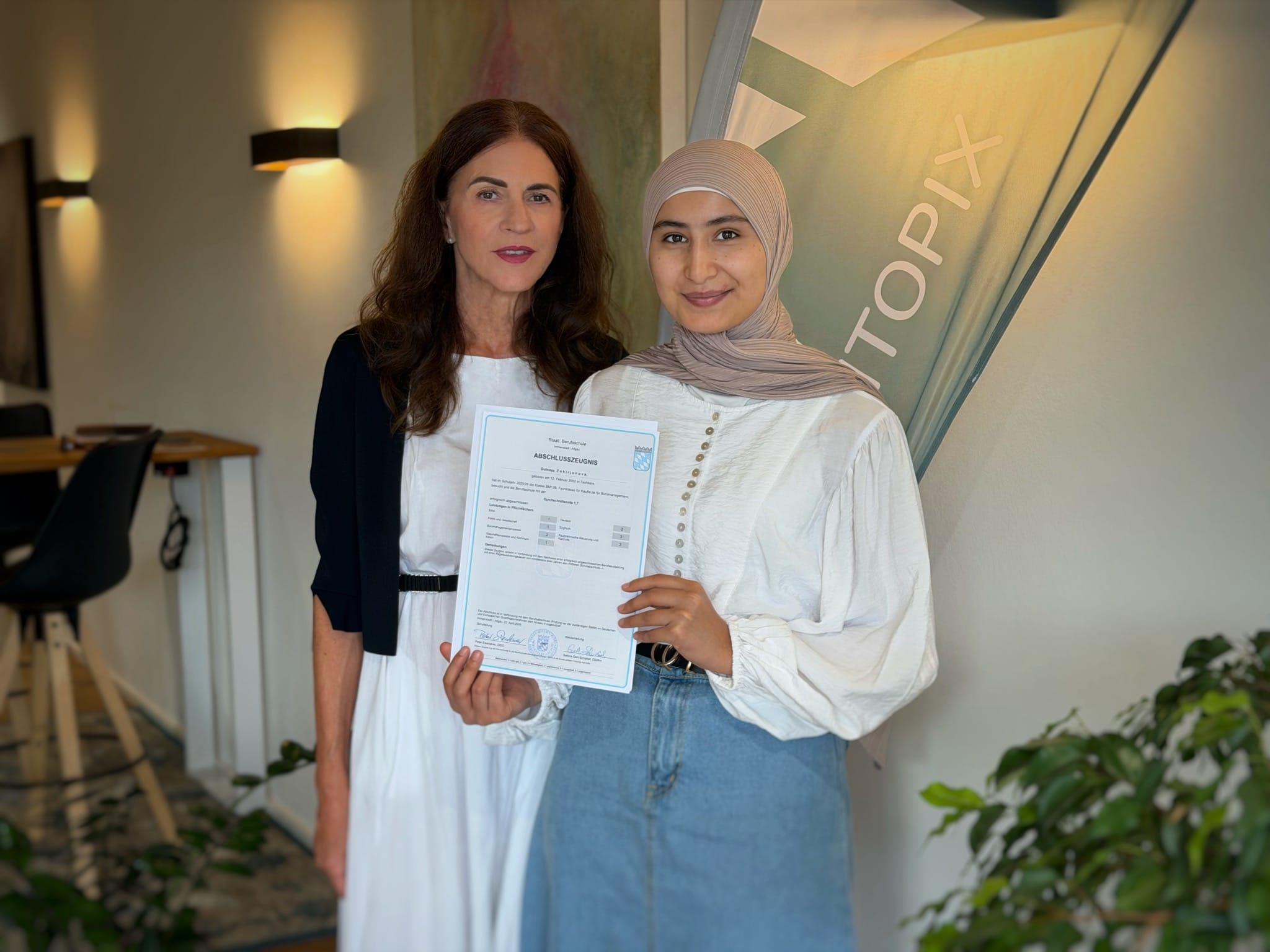
In the end, she completed her training with a grade of 1.7 from the IHK.
Today, Gulnoza works at PANTOPIX as an assistant in the Finance and Controlling department—exactly where she has discovered her greatest strength. She would like to continue her education, perhaps by studying while working, or by completing a continuing education program to become a certified accountant later on.
Gulnoza has now arrived in Germany. She enjoys visiting lakes and going to the mountains. She likes nature, the greenery, and the milder temperatures. Still, her life here isn’t entirely straightforward. As a non-EU citizen, she has to prove her right to stay again and again. Although vocational training is specifically designed to qualify young talent for a company’s own needs and subsequently retain them, PANTOPIX had to explain to the authorities on multiple occasions why the apprenticeship position—and later the job itself—had not been filled by a German or European applicant.
Gulnoza is familiar with these questions. And she knows what it’s like to often have to work harder just to get the same opportunity. The language, the bureaucracy, the many rejections—her journey wasn’t easy. Still, she’s glad today that she got on that train back then.
At PANTOPIX, we are proud of the path Gulnoza has taken. In a short time, she has not only grown professionally but has also found her place in the company through her great perseverance, discipline, and openness. Today, we value her as a reliable colleague who thinks proactively, takes on responsibility, and enriches our team both professionally and personally. We are all the more delighted that she is continuing her career at PANTOPIX.
We will be happy to inform you regularly about new articles, videos or podcast episodes.