The potential of AI in technical communication: applications and practical examples
24. August 2023
Artificial intelligence (AI) refers to the simulation of human intelligence by software. AI has recently attracted a lot of attention as it offers the possibility of automating manual tasks. But what advantages and potential does AI actually open up for technical communication?
At the end of 2022, OpenAI released the groundbreaking chatbot ChatGPT. With its ability to generate human-like text and answer complex questions, this chatbot raises great expectations in terms of intelligently providing the right information. However, the innovative power of this technological advancement also raises the question of whether we need to jettison tried and tested approaches and methods in technical communication – from metadata to semantic information models and knowledge graphs.
Generative AI and large language models explained simply
To explain the possible applications for technical communication, we would like to introduce the terms Generative AI and Large Language Models. Generative AI refers to a form of artificial intelligence that is able to create new data or content that is similar to the existing data in its training data set. It uses complex models and algorithms to create text, images or videos, for example, that could have been generated by humans.
ChatGPT is an example of a generative AI. The chatbot, which is based on a generalized pre-trained transformer and gives amazing (in a positive sense) answers to a wide variety of user requests (so-called prompts) in real time. This was made possible by Large Language Models (LLM), which have learned to process and analyze language based on huge amounts of data. Among other things, words are related to each other using statistical calculations and represented as vectors (embeddings). The calculated proximity of two words correlates with semantic proximity, without the language models having any understanding of language or the world as such.
In our opinion, however, it is not advisable to provide customers with precise and often safety-critical technical information, such as repair instructions, on the basis of a language model alone. But if there is hype about these technologies, where do we see potential applications and added value? We have identified the following scenarios for you and tested them in practice.
Possible applications of AI in technical communication
Information classification with AI
A “classic” task of technical communication is the provision of information (documents and topics). Unfortunately, these usually have little or no metadata, especially when it comes to legacy data, so that a targeted search in the provision systems (e.g. via facets) is not possible. Large language models offer a very good opportunity to analyze and classify information resources. The results of the classification become really powerful when LLMs are supplemented with factual domain knowledge, e.g. via knowledge graphs, and/or trained for a specific task (keyword: fine tuning with ground truth data).
Automatic information extraction
Knowledge often lies dormant in various documents within a company. Large language models have proven to be very useful for extracting knowledge from documents, such as the technical features of products. Why? Because they are able to identify and extract exactly the information that is relevant based on the prompt. The extracted information can then be fed into a knowledge graph, for example. The filling of a knowledge base can thus be automated – for both structured and unstructured information. Here too, these services improve when the implicit knowledge of the LLMs is substantiated by explicit, structured knowledge, e.g. from a knowledge graph.
Informationsklassifikation und Informationsextraktion mit Large Language Models und Wissensgraphen
Dialog-guided search and troubleshooting
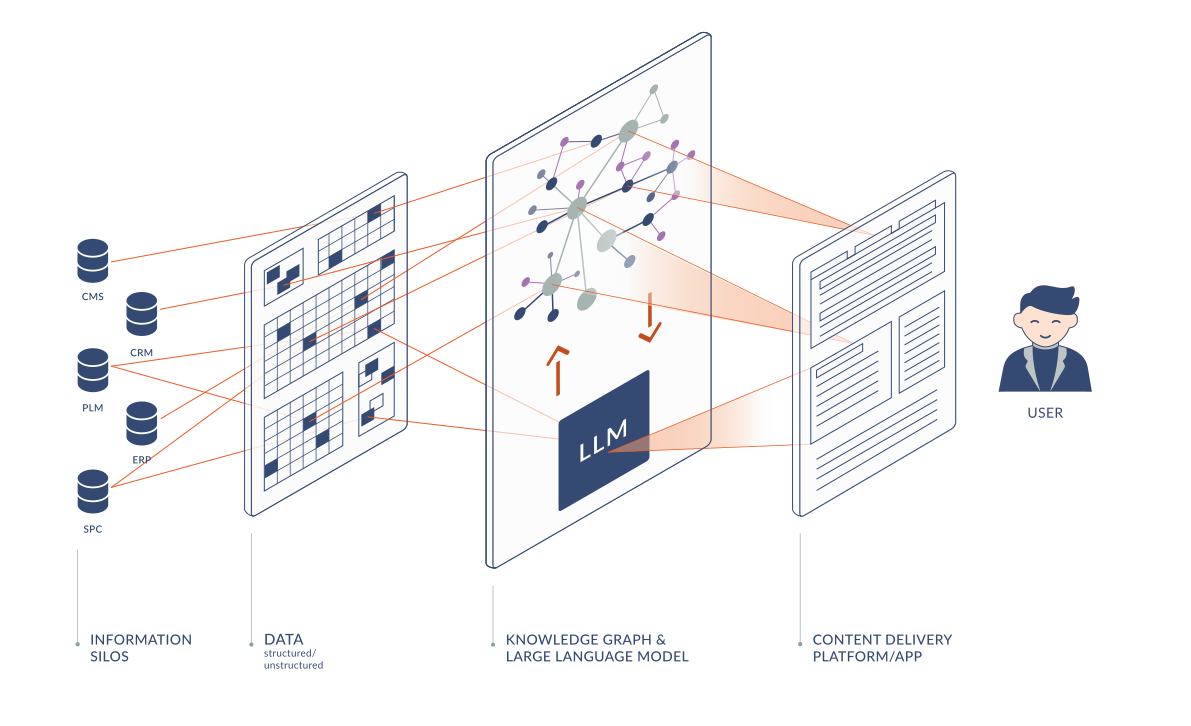
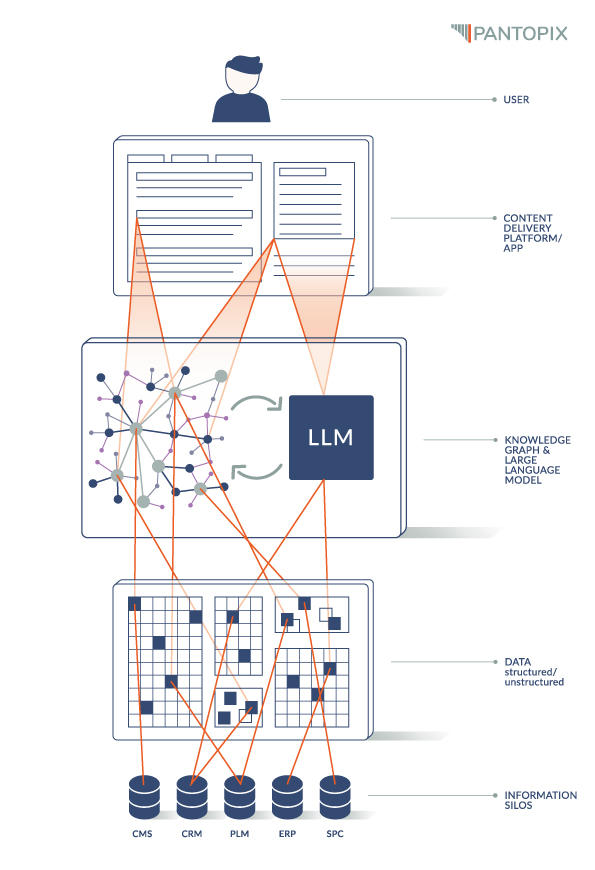
We use knowledge graphs in various projects to link verified information from different information silos. We make these available to users via an application. We will continue to adhere to this approach in the future. After all, only the content released by the relevant departments is reliable. At the same time, it is not always easy to find the information you really need. We see great potential in LLMs to guide users to the right information in question-and-answer scenarios without having to generate the answer themselves. This is highly relevant for troubleshooting or diagnostic activities, for example.
AI-supported content creation
This approach is still in its infancy: ChatGPT can create new content based on existing content, e.g. in a private instance. Against the background of product liability and safety, this approach sounds daring. But what if, in future, ChatGPT were to support technical editors with a draft, say of a new topic to be created? The task of the technical editors would then be to prepare, verify and approve this draft. This ensures that only quality-assured content is provided. The creation time of the content can be significantly reduced by using ChatGPT.
Why metadata and knowledge graphs are still crucial
We keep a cool head in the face of all this hype. We bring clarity to the technology jungle and show you the way. We stick to the tried and tested and add new technologies such as LLMs and ChatGPT where it really makes sense to do so. So that you are in a position to optimally support your processes and provide your customers with the right information in line with their needs.
Our approach is based on various pillars. Depending on where you stand; depending on which strategy you are pursuing. Metadata, semantic information models and knowledge graphs are not yesterday’s news. They help us and you to provide information intelligently. And they also help language models to become even better – because the better the input, the better the output.
Incidentally, American researchers recently discovered that GPT responses have deteriorated over time.
Karsten Schrempp
Managing Director | PANTOPIX
We will be happy to inform you regularly about new articles, videos or podcast episodes.