PIM system with Knowledge Graph: Architecture and Use Cases

Artikelbild PIM-Systeme auf Basis von Wissensgraphen

12. June 2024

A PIM system with Knowledge Graph offers a new approach to creating and managing product information efficiently and making it available across all channels. Traditional PIM systems are increasingly reaching their limits: The growing complexity of product portfolios, heterogeneous data sources and a lack of integration make consistent data management considerably more difficult.

Added to this is the increasing need to compare own products with competitor offerings in order to make well-founded market and portfolio decisions. Without a central, networked database, inconsistent data quality and manual processes lead to inefficiencies – especially for sales managers who rely on up-to-date and complete product information.

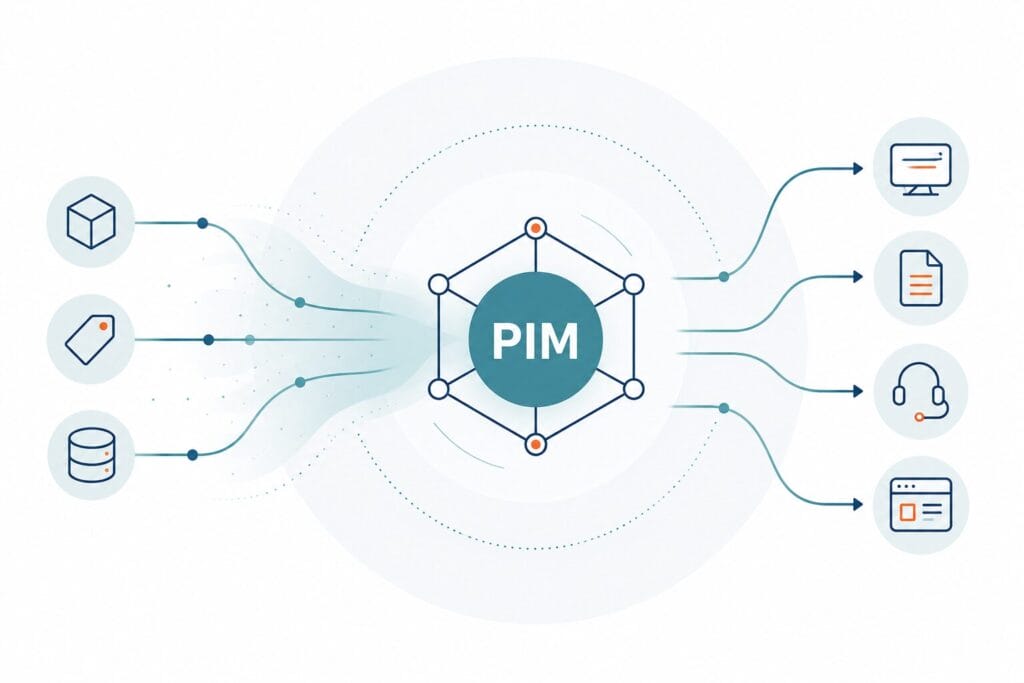
A PIM system with Knowledge Graph addresses precisely these challenges by integrating data from different sources, correlating it and providing it in a consistent, semantically networked structure. This creates the basis for more efficient processes, better analyses and more informed decisions.

Business use case: Product navigator for sales managers

Sales managers are often faced with the difficult task of collecting product offering information from various sources – a time-consuming and error-prone process. In addition to navigating internal data sources, they have the responsibility of manually tracking competitor product offerings on various external websites. This complexity makes it difficult to find information quickly and has a negative impact on strong customer relationships and competitiveness. To address these issues, we use a knowledge graph at the heart of the PIM system. It integrates product information from different data silos, which is displayed in a uniform structure in a central location. The product navigator thus serves as a customized access point to the knowledge graph that meets the specific needs of sales managers.

System architecture of a PIM system with Knowledge Graph

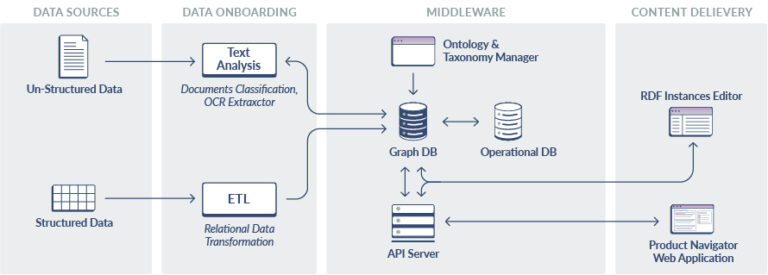
The PIM system architecture consists of four main layers and includes data sources, data transfer, middleware and content delivery.

Artikelbild PIM-Systeme auf Basis von Wissensgraphen

Data sources

We distinguish between structured and unstructured data. Unstructured data includes technical documents and competitor websites. These are used to extract specific product details and descriptions that are stored as RDF in the knowledge graph. Structured data consists of product datasheets and relational data sources that contain predefined attributes for product features such as efficiency and rating.

Data transfer

In the data transfer layer, product data is continuously extracted from competitors and stored in the PIM knowledge graph. This includes crawling, classifying, extracting data and RDF generation of documents. We search competitor websites to collect technical product documents. Relevant information is extracted using a trained OCR model. Structured data from relational databases is transformed and integrated into the knowledge graph. This pipeline works automatically and includes data validation.

Middleware

The ontology and taxonomy manager maintains the PIM ontologies and taxonomies. The relational database stores operational data such as access and control lists. The knowledge graph stores all RDF data in interconnected graphs, which increases the efficiency of RDF queries. The API server defines a set of API calls that are used by the content delivery layer for various applications, including the product navigator web application.

Content Delivery

The content delivery layer is responsible for making the integrated and processed data available to end users. It includes web interfaces, mobile applications and integration with other enterprise systems. This layer ensures that the right data is accessible to the right people at the right time and provides a seamless user experience. It supports advanced search and visualization tools that enable sales managers and other users to easily access the consolidated product information and use it for decision making and strategic planning.

Advantages of PIM systems with Knowledge Graph

  • Data integration: Knowledge graphs enable the integration and consolidation of product information from different data sources and silos. This ensures a uniform and central database that minimizes inconsistencies and improves data quality.
  • Flexibility and scalability: The flexible structure of knowledge graphs makes it easy to add and manage new data sources and product attributes. This is particularly important in dynamic markets where product portfolios and requirements can change quickly.
  • Extended query options: Knowledge graphs support complex queries and analysis that go beyond simple data retrieval. Sales managers can, for example, carry out detailed comparisons of product features and market segments, which leads to more informed decisions.
  • Automation and increased efficiency: The centralized management and automatic updating of product information reduces manual work processes. workflows are reduced. This increases efficiency and reduces the susceptibility to errors, which is particularly beneficial for sales and marketing teams.
  • Improved competitive analysis: Knowledge graphs enable detailed tracking and analysis of competitors’ product offerings. This information can be integrated directly into the PIM system, giving companies a competitive advantage.
  • Easy maintenance and expansion: By using standardized ontologies and taxonomies, PIM systems based on knowledge graphs can be more easily maintained and expanded. This leads to better long-term sustainability and adaptability of the system.

In summary, knowledge graphs for PIM systems provide a robust and flexible platform that significantly improves both data management and decision-making. They help to increase efficiency, ensure data quality and make companies more competitive. These benefits make knowledge graphs an ideal choice for modern PIM solutions.

Read the paper Product Information Management Systems Powered by Knowledge Graphs“.

Amir Laadhar and Nikhil Acharya, Knowledge Engineers at PANTOPIX , gave a presentation on this topic at ESWC 2024 in Crete.

Maximilian Gärber Technical Consultant PANTOPIX

Maximilian Gärber

Technical Consultant | PANTOPIX

We will be happy to inform you regularly about new articles, videos or podcast episodes.

Knowledge

Find out more about networking information

Share this post
Kopiert!

Search

Search