
09. July 2026
Technical information has been digitized in companies for years, yet many still struggle to make that knowledge available in the right context. Information remains isolated in PDFs, content management systems, service portals, or databases, making it virtually impossible for machines to understand and utilize it. With the increasing use of AI, semantic search, and digital service platforms, it has become clear that traditional document-centric information structures are reaching their limits. Standards such as iiRDS, on the other hand, are gaining importance in this context.
But what exactly is iiRDS, how does the standard work from a technical standpoint, and why is the topic of metadata becoming strategically relevant right now? This article provides an overview of the structure, applications, and significance of iiRDS for modern information and AI systems.
What is iiRDS? The standard explained simply
iiRDS (Intelligent Information Request and Delivery Standard) is a vendor-neutral metadata and exchange standard for technical documentation. It enables platform-independent and content-neutral retrieval and delivery of digital information. The standard does not standardize content; rather, it defines only the delivery format so that information from different systems can be consolidated without restricting users in the creation of technical documentation.
The technical standard was developed as early as 2016 by a group of experts at tekom to fundamentally change the way information is provided in technical communication. In 2018, the iiRDS Consortium—comprising over 30 national and international members—took over the maintenance, further development, and dissemination of the standard. As one of the founding members, PANTOPIX is also very interested in actively and practically supporting the development of this industry standard.
How does iiRDS work? Structure and components
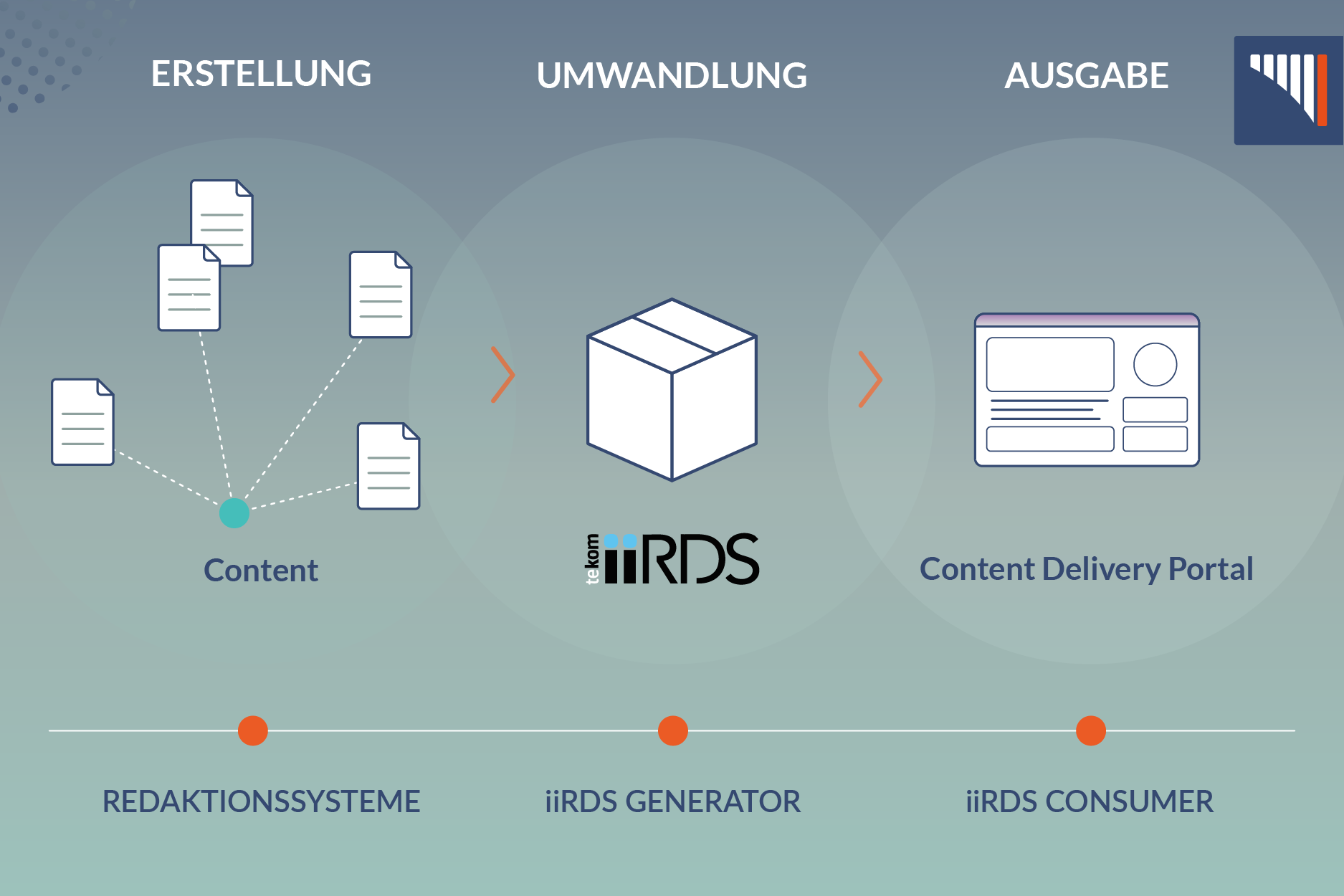
iiRDS is based on the idea of not only providing technical information in the form of documents, but also describing content semantically and making it usable across systems. To this end, the standard combines content, structured metadata, and defined exchange mechanisms into a single model.
Technically, iiRDS consists of three key components:
- a standardized package format for exchanging information
- a semantic metadata model for describing content
- as well as a specification that defines the structure, relationships, and use of this data.
The package format is based on a ZIP container. This container holds both the actual content—such as PDF, HTML, or XML documents—and the associated metadata. This allows information, including its description, to be transferred between different systems, such as CMS, CCMS, service, or content delivery platforms.
The metadata is based on RDF or RDFS (Resource Description Framework). This model describes information not only through simple keywords, but also through semantic relationships. Content thus becomes part of a knowledge graph in which, for example, products, components, target audiences, activities, or error situations are logically linked to one another.
This is based on an ontology that defines standardized terms and relationships between pieces of information. This enables different systems to interpret content within the same context and use it across systems.
Metadata thus plays a central role within iiRDS: it links content, user context, and output systems. This is what makes it possible to dynamically deliver information—for example, based on the machine, user role, maintenance step, or usage scenario. Through defined request and delivery mechanisms, target systems can retrieve exactly the information they need.
In our overview of metadata management in technical communication, we show how metadata can be systematically modeled, managed, and made usable across different systems.
iiRDS in the Context of Other Standards and Systems
iiRDS does not stand alone, but rather complements existing standards and technologies in the fields of technical documentation and Industry 4.0. Its connection to DITA-based content strategies and component content management systems (CCMS) is particularly relevant. While DITA and CCMS primarily enable the structured creation and management of modular content, iiRDS provides a standardized mechanism for exchanging this information, along with metadata, between different systems.
There are also close overlaps with VDI 2770. Both standards aim to make technical information available in a digital and standardized format, but they have different focuses: VDI 2770 focuses primarily on the standardized exchange of document-centric manufacturer documentation, whereas iiRDS focuses on the semantic description and use of individual information building blocks.
Technologically, iiRDS is based on Semantic Web concepts. RDF, ontologies, and knowledge graphs combine to create a semantic information model that describes content in a machine-readable format and reveals relationships between pieces of information. As a result, iiRDS is becoming increasingly relevant for knowledge graph approaches and data-driven service architectures.
Watch our webinar recording to learn more about how metadata standards can help make technical communication future-proof. Dr. Martin Ley (PANTOPIX) and Jan Gräter (gds) shared practical insights (Only in German).
iiRDS in Practice: Industry Case Studies
In practice, industrial companies begin to explore iiRDS when they want to use their technical information across different systems—for example, in digital service portals, spare parts catalogs, or AI-powered assistance systems.
Typical triggers include:
- Heterogeneous content and system environments
- Lack of consistency between service information
- Significant manual effort required for maintaining and providing information
- Unstructured knowledge bases for AI and search systems
- Increasing demands on self-service and service processes
A typical scenario in mechanical engineering: A service technician is working in a production facility with equipment from various manufacturers. In the event of a malfunction, he needs quick access to maintenance information, spare parts data, error messages, or step-by-step instructions—regardless of which system the information originally came from.
With iiRDS, this content can be semantically described and delivered in a context-sensitive manner via central service or content delivery portals. This ensures that technicians ultimately receive exactly the information relevant to the specific machine, component, user role, or error situation.
Similar requirements also arise in medical technology and plant engineering, where technical information must remain consistently available throughout long product lifecycles. In software and service portals, iiRDS also supports intelligent search, filtering, and dynamic display of information.
In doing so, companies primarily pursue operational goals:
- Reducing Search Times for Service and Maintenance Teams
- Lower service and support costs
- Faster troubleshooting
- Higher first-time fix rate in the field
- Consistent information flow across different systems
iiRDS is thus increasingly becoming a technical foundation for modern digital service and information platforms.
Why iiRDS Is Becoming Relevant for AI and Semantic AI Applications
With the increasing use of AI systems, iiRDS is becoming significantly more important. The reason for this lies in the semantic structure of the metadata: information is not only stored, but also described in a way that machines can understand and linked together. This results in the structured, context-sensitive, and machine-readable information that modern AI systems rely on.
iiRDS is particularly relevant for semantic search systems, Retrieval-Augmented Generation (RAG) architectures, and AI-powered assistance systems. Instead of simply searching through documents, AI systems can interpret content in context and provide the specific information needed for a given situation.
Chatbots, digital service assistants, and intelligent maintenance systems also benefit from this. For example, thanks to standardized metadata, AI can identify which product is involved, what the user’s role is, or which step in the process is currently being performed. This allows information to be filtered more precisely and presented based on the specific situation.
When combined with knowledge graphs, this creates a structured knowledge base that makes technical information significantly more usable for AI systems. As a result, iiRDS is increasingly evolving from a pure exchange standard into a key foundation for intelligent information provision in industrial settings.
In the article “Why Your AI Support Chat Gives Incorrect Answers—and How to Fix It,” you’ll see how we created a product ontology based on iiRDS to improve a technical question-answering system.
How do companies get started with iiRDS?
In practice, the transition to iiRDS usually takes place in stages. Only a few companies implement the standard company-wide right away. The implementation often begins with a clearly defined pilot project in the service or documentation environment.
Typical starting points include digital service portals, spare parts catalogs, technical documentation, or the integration of editorial and content management systems. This approach is particularly well-suited for use cases where information is currently maintained in multiple places or is difficult to find.
For initial pilot projects or tests, the iiRDS Open Toolkit is also available as a free tool that allows users to create iiRDS packages and metadata structures without the need for complex system integration. This enables companies to gain practical experience with the standard before implementing larger information or service architectures.
Prerequisites and Assessment of Maturity
A key prerequisite for implementing iiRDS is, above all, a sufficiently structured content base. Companies do not need an entirely new system landscape, but they do need a basic understanding of metadata, modular content, and semantic information models. Existing CMS or CCMS systems can often be integrated via interfaces or extensions.
In addition to the technical infrastructure, the involvement of organizational roles is also important. Successful iiRDS projects typically require close collaboration between technical writing, service, IT, product management, and those responsible for digitization.
In practice, companies often differ in the maturity level of their information architecture. While some are already working with modular content and metadata, others still face the challenge of consistently structuring their distributed documentation and knowledge resources.
Maturity models can help systematically assess the current state of information provision and highlight typical developmental steps toward semantic and AI-enabled information architectures.
iiRDS at a glance
iiRDS (Intelligent Information Request and Delivery Standard) is an international standard for the intelligent provision of technical information. It defines metadata and a package format to make content accessible across systems.
More information and materials can be found on the official iiRDS website.

Karsten Schrempp
Managing Director | PANTOPIX
We will be happy to inform you regularly about new articles, videos or podcast episodes.

Knowledge
Learn more about connecting information