
30. June 2026
The current discourse on agentic AI in business points to the direction in which artificial intelligence is very likely to evolve. The path leads away from isolated assistant functions toward systems capable of planning tasks, evaluating information, coordinating processes, and preparing decisions. Anyone who takes this development seriously will quickly arrive at a key insight: Agentic AI requires a robust business context and a structured knowledge base. Without this context, AI systems may be impressive in theory, but their reliability remains limited.
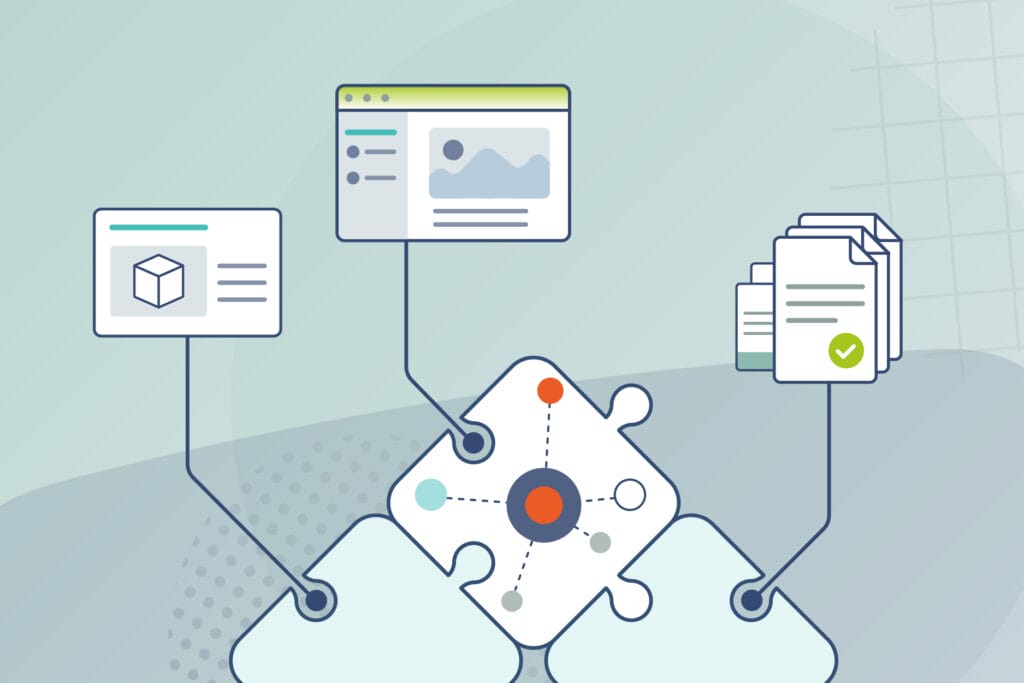
In his article “How to Build a Semantic Backbone,” Andreas Blumauer of Graphwise provides a very clear explanation of how such a context can be built from a technical and methodological perspective: through taxonomies, ontologies, knowledge graphs, semantic models, and architectures built on top of them, such as GraphRAG. This is an important and appropriate path forward. Anyone who wants to implement agentic AI and modern AI applications in their company will have no choice but to rely on such a semantic knowledge base.
It became clear at the AI-READY Summit 2026 in Nürtingen that this discussion has now also found its way into practical application. In many conversations, the focus was no longer on whether AI is relevant, but rather on how it can be reliably and productively integrated into existing business processes. A remarkable consensus emerged: It is not the models that pose the greatest hurdle, but rather the quality, structuring, and interconnection of the underlying knowledge.
For many companies, therefore, the challenge begins much earlier: Many companies are not even faced with the question of whether they should expand ontologies or build knowledge graphs for agentic AI, but—much more fundamentally—whether they even have the organizational, content-related, and systemic foundation needed to meaningfully launch this process.
A requirement for a knowledge base? That's the reality of business.
The approach described is absolutely correct and necessary: First, terms are organized; then, meanings are modeled; next, relationships are established; and finally, a semantic knowledge base is created that AI systems can use reliably. This is the only way Agentic AI can utilize corporate knowledge in a context-sensitive and traceable manner.
In reality, however, companies are first and foremost faced with their legacy system landscapes: fragmented data sets, terminologies that have evolved over time, and an information architecture that is often lacking for AI applications. They are faced with product information that, while available, is maintained differently across various systems. They are faced with thousands of documents that are valuable from a technical standpoint but have not been consistently structured or tagged with the correct metadata. They are faced with processes in which many interdependencies function only because experienced employees know where to find specific information and how to interpret it.
Establishing a semantic foundation requires that a company understand its information objects, concepts, relationships, and responsibilities at least to the extent necessary to create a model. This prerequisite is often not met—not because companies give too little thought to AI, but because, for years, the operational reality of information has not been designed with machine readability, reusability, and semantic interconnectivity in mind.
Many companies have knowledge, but no robust knowledge base for AI
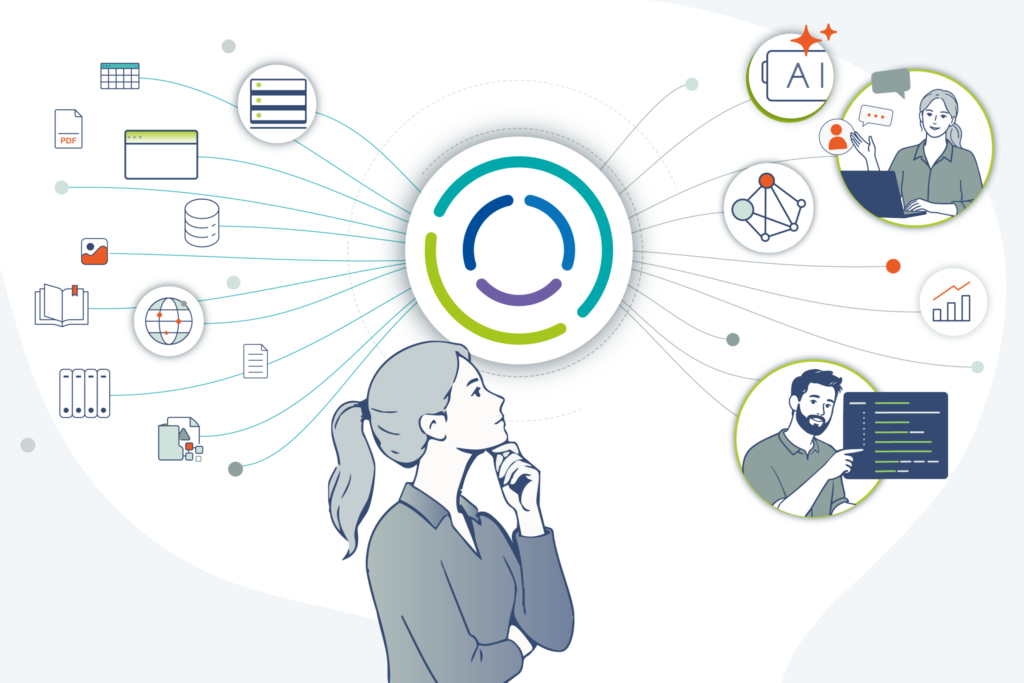
Almost every company possesses vast amounts of knowledge: product knowledge, service knowledge, sales knowledge, technical knowledge, process knowledge, and experiential knowledge. The problem is that this knowledge is not available in a format that can be systematically linked, automatically analyzed, and used for AI applications, RAG, or GraphRAG.
There is a difference between available information and a robust knowledge base. Available information can be found in PDFs, spreadsheets, PIM systems, ERP fields, tickets, SharePoint structures, manuals, or specialized departments. A knowledge base is only established once it is clear which information is valid, how it is structured, how it relates to other information, which terms are used, which source is authoritative, and who is responsible for ensuring its quality and timeliness.
These aspects form the foundation for knowledge management for AI, data governance, and the development of a knowledge graph.
For people, this situation is stressful, but often still manageable. They ask colleagues, are familiar with historical exceptions, interpret terms based on context, and manually cross-check information. AI systems, however, cannot reliably work with knowledge that is held together solely by human experience.
Information Maturity as a Requirement for Knowledge Graphs and GraphRAG
In many AI initiatives, the conversation quickly turns to tools, models, and use cases. This is understandable, because that’s where visible progress is made. A prototype can be demonstrated. A chatbot can be tested. A RAG system can provide initial answers based on internal documents.
However, building a solid information foundation for AI begins with less visible work, such as clarifying questions like these:
- What information is business-critical?
- Which objects need to be described in the first place?
- Which objects need to be described in the first place?
- Which relationships between these objects are relevant?
- Which terms are binding?
- Which systems contain which information?
- What level of quality is sufficient?
- Who gets to define terms?
- Who decides in the event of a dispute?
The challenge lies in increasing the company’s information maturity and establishing a common technical language. Only then can taxonomies, ontologies, and knowledge graphs be developed on a solid foundation.
This phase is important and should not be underestimated. Anyone who skips it will not be able to create a stable knowledge base, even with modern semantic technologies. In that case, the semantic foundation may end up being nothing more than an ambitious project that fails to cope with the realities of the information landscape.
Information readiness is a leadership responsibility
For a long time, many companies viewed information through a functional lens. Sales needed different information than customer service. Technical documentation had different requirements than product management. Marketing, engineering, e-commerce, and compliance each worked with their own slices of the same reality. Today, this specialization means that AI and automation initiatives are encountering a landscape that is rich in subject matter expertise but structurally fragmented.
Information maturity means not only integrating this fragmentation from a technical standpoint, but also organizing it from a subject-matter perspective. It is not enough to connect systems if it remains unclear whether the same terms mean the same thing or whether different terms describe the same thing. It is not enough to make data available if its validity, quality, and relationship to other information are not clear. And it is not enough to migrate content to a new system if the underlying meaning has not been clarified.
Building a semantic knowledge base often requires cross-departmental collaboration. It requires:
- Fields of study that define meaning
- Person Responsible for Information Quality
- Data Governance Structures
- People who make architectural decisions that extend beyond individual systems
Even if a knowledge graph project starts as a proof of concept on a smaller scale—for example, as a product—it still requires commitment from the company. The information base must be viewed as strategic infrastructure.
Conclusion: GenAI, RAG, and GraphRAG make the quality of the knowledge base visible
Generative AI, Retrieval-Augmented Generation (RAG), and GraphRAG reveal where companies actually stand today. Generative AI can generate content, RAG can make existing knowledge accessible, and GraphRAG promises a deeper understanding of subject-matter relationships. However, all of these approaches are only as good as the underlying knowledge base for AI, the quality of the metadata, and the consistency of the terms used.
For companies, the path to a semantic knowledge base therefore does not begin with ontologies or knowledge graphs, but with an honest assessment of their own information landscape. Only once these fundamentals have been clarified can taxonomies, ontologies, knowledge graphs, and GraphRAG realize their full potential and become a robust foundation for agentic AI, automation, and digital business models.
The “Semantic Backbone” described by Andreas Blumauer is a necessary goal. The key point, however, is that many companies must first create the conditions necessary to successfully follow this path.

Sandy Hedig
Marketing Manager | PANTOPIX
We will be happy to inform you regularly about new articles, videos or podcast episodes.

Knowledge
Learn more about connecting information