15. June 2021
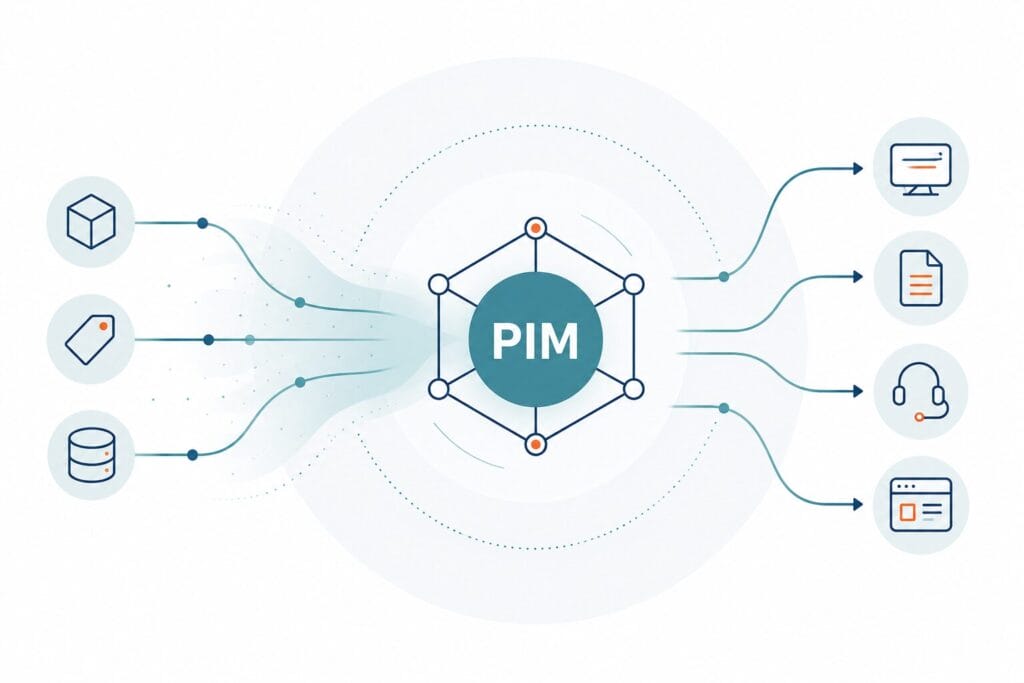
In a PIM system, all of a company’s relevant product data is managed centrally and stored or referenced in a media-neutral manner in order to make the data available for various output channels. You can find out more about the basics of a PIM system in the article ‘Simply explained: What does PIM mean?
Analysis phase: The basis for the introduction of a PIM system
Before a uniform product information management system can be created in the company, the status quo must first be analyzed. In this way, we can develop tailor-made solutions in a holistic approach and prepare your company for future challenges in the best possible way.
First, the existing database must be comprehensively analyzed, including the systems used (ERP, CMS, MAM, etc.) and processes as well as the website, online stores and publications. The insights gained in this way make it possible to simplify work processes, integrate the existing systems through interfaces and thus design a suitable product information strategy for your company.
Data modeling in the PIM system: structure and management of product data
Modeling the existing product data lays the foundation for the PIM system: We define a suitable, media-neutral data schema for all systems to be integrated, which can then be used for a wide variety of purposes within the company.
Various product data requirements are taken into account:
- Hierarchy of products
- Technical and general characteristics of products
- Various media files (texts, tables, images, documents and other media)
- Country-specific offers and product ranges
- Reusability
- Consideration of channel-specific requirements (e.g. SEO, classifications, store)
- Content targeting (tailored to the respective customer group)
The main advantage of data modeling and media-neutral management is that product information only needs to be entered into the database once. This saves costs and resources. In addition, different media channels (print, online, social) can be served without great effort and always with the same high quality and specific requirements (regarding customer groups, etc.).
Publication rules in the PIM system: How to control your data processing
Defining a set of rules for publications is also an important success factor for a PIM system and the automation of many processes. To do this, we need to answer a few basic questions together:
- Which data from which systems is important for which publications?
- How often should certain publications take place?
- Are there rules for the output of certain classes of information (e.g. tables for technical product data)?
- Which languages need to be served?
- Are certain products and product data not made available for certain regional markets?
- What adjustments need to be made to the wording depending on the country?
- Are conversions of technical units or currencies necessary?
Output definition in the PIM system: Outputting data according to channel
The great strength of a PIM system lies in the correct presentation of information. The presentation of your product data can vary significantly depending on the user group and media channel. For example, there is a considerable difference between a print and an online presentation. An output definition determines certain types of data output for the individual channels right from the start. For example, meta tags and rich snippets will always be created for new products in the online store in future in order to improve search engine rankings and generate site visitors via the additional information. Certain classifications in the PIM system also allow customer data to be sorted very easily and assigned to defined groups.
In principle, various advantages can be derived from this: The output of all data and content is at a consistently high level of quality, automated classifications save effort and costs, and search engine optimization is greatly facilitated.
System selection: Finding the right PIM system for your company
With the comprehensive analysis of existing product data and systems, data modeling and the definition of publication rules and output, we have determined the requirements for a PIM system. This should also result in the strategic objective for your product information management: what do you want to achieve with your PIM?
Based on these requirements, we can now use our many years of experience to select the most suitable PIM system for your company from a selection of high-quality systems from well-known providers.
Implementation - the PIM system takes shape
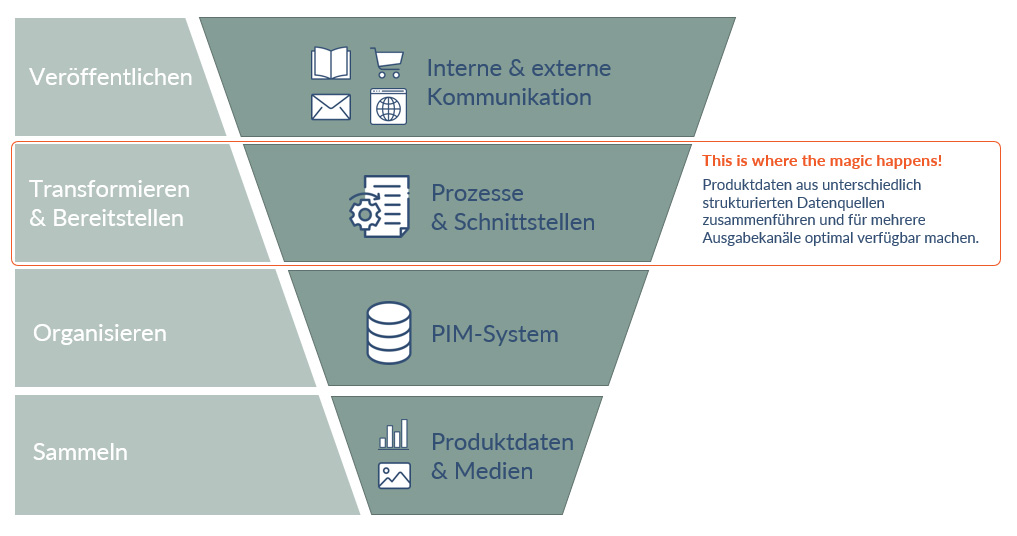
Opting for a PIM system significantly simplifies numerous processes relating to your product data. This data is stored on a platform-independent basis and can therefore be prepared for a wide variety of communication channels as required. However, to ensure that all product data can be used via the new system, a very important project step now follows: the implementation of the system and the integration of the existing systems (ERP, MAM, CMS, web store, CRM, etc.) using interfaces (APIs) and the migration of the data.
Transforming and providing the data via interfaces for different output channels is the most important point in a successful implementation: this is where the magic happens!
We make sure that the installation runs smoothly and that you can actually use a powerful PIM at the end.
With expertise and many years of experience, we accompany you on the way to your individual product information management – from the conception and selection to the implementation of the suitable system and integration into the existing system landscape.
Maximilian Gärber