
Projekte
Agent-based AI + knowledge graph: How Agentic RAG works in ZEISS Service Copilot
The Service Copilot is an assistance system that supports the service teams at ZEISS RMS in their work by providing intelligent information. It combines a knowledge graph as a single source of truth with artificial intelligence.
Feedback from more than 1,000 users has been extremely positive: instead of spending a long time searching for information in numerous different systems, employees at all support levels now access the same intelligent service app. Thanks to its special IT architecture, this app provides context-based answers that significantly improve service quality and customer satisfaction.
Service Copilot was developed in close collaboration with ZEISS Digital Partners (ZDP). The PANTOPIX development team provided both consulting and support services for the development of the application’s front and back ends. PANTOPIX contributed its proven expertise, particularly in the area of agent setup for AI-based systems.
Semantic basis for agentic AI
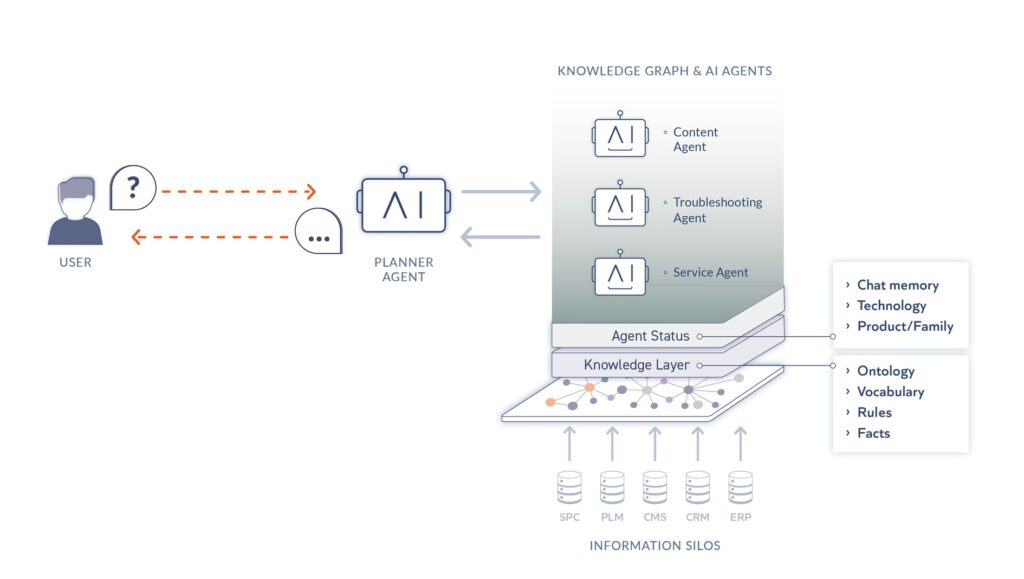
At the heart of ZEISS Service Copilot is its semantic foundation: the knowledge layer comprises a knowledge graph with a product ontology, terminology for the entire system, and rules and facts that control the behavior of the artificial intelligence in the system.
AI here does not just mean a large language model (LLM) alone, which generates generic and therefore potentially unreliable answers. An agentic AI architecture with an orchestrating agent at its center is used. This planner agent autonomously decides which steps are necessary to solve the problem and then controls several agents specialized in their own areas of responsibility.
Why does AI still need a knowledge base?
A multi-agent system that uses an LLM, such as in Service Copilot, needs a stable information base in order to arrive at reliable answers. A language model alone is not enough for this. This is where the knowledge base comes into play. In the form of an ontology, it provides the LLM with a clearly defined structure and context that can be used for decisions and classifications.
In principle, NLP technology enables the LLM to perform named entity recognition (NER), i.e., it automatically recognizes and classifies objects (entities) in texts. But it is not infallible. Ontology ensures that the AI knows what an entity can be and how it relates to other things. This leads to a better understanding of the user’s intention, eliminates ambiguity, and creates context through networked information.
All AI agents in the system have full access to this knowledge base and also share the chat memory to ensure that everyone is on the same page and can work together.
Process for a user question in ZEISS Service Copilot
When a service employee uses the dialog-oriented entry point of Service Copilot and asks a question in the AI chat, the LLM does not generate a response directly, as is the case with GenAI. Instead, the central Planner Agent acts as the brain for the entire agent system.
The planner agent works according to the “plan and execute” principle. Instead of simply distributing the question to one of the sub-agents, it creates a multi-level, structured plan (task list) to resolve the request.
AI agents with different skills work together
The central planner communicates with various types of agents and thus controls the flow of information. It uses the interaction agent to conduct a dialogue with the user in natural language. The user’s question is analyzed in terms of its intention. In addition, the context relating to the machine in question, its components, and the service history is established. If necessary, queries are clarified.
The inference agent is used as an aid when information is missing. It then derives new conclusions (e.g., causes, correlations) from the semantic information in the knowledge base.
The technical agents have special expertise in their respective areas:
- The content agent provides step-by-step instructions or unstructured information (e.g., operating instructions).
- The troubleshooting agent analyzes errors and searches for the causes of problems.
- The service agent retrieves service-related or device-specific information (e.g., serial numbers, status reports).
The planner agent compiles relevant information and constantly decides whether further information is needed to answer the user’s question. If so, the planner agent creates a new task list. If not, it uses the interaction agent to generate a source-referenced answer in natural language.
Advantages and benefits of knowledge graph-based Agentic RAG
The agent-based system architecture, combined with a knowledge base (ontology, rules, facts), enables an intelligent service app such as ZEISS Service Copilot to better recognize and understand contexts and thus reliably answer even complex questions.
The modular structure makes the system easy to customize and expand. At the same time, interactivity improves the user experience because the chat asks more specific questions and provides clear answers.
Overall, an AI-supported chat that uses an agent system and a knowledge graph ensures higher response quality and more efficient service processes – and thus creates truly intelligent service information.
Learn more about the project—the challenges and solution—in our case study “Service Copilot from ZEISS – The intelligent assistant every service team desires”.
About ZEISS RMS
ZEISS Research Microscopy Solutions (RMS) specializes in the development and manufacture of microscopes and imaging technologies for various applications. The company offers a wide range of microscopes, from light microscopes and electron microscopes to X-ray microscopes. These instruments are used in various fields, including life sciences, materials science, and industry.
Would you like to support your service with an intelligent assistant?
Feel free to contact us without obligation.
Ihr Ansprechpartner
Maraike Heim
Head of Marketing
- maraike.heim@pantopix.com

Improving service quality with networked information
Production processes are being continuously optimized and automation solutions are being promoted. However, in the service department, where customers expect quick responses, precise solutions, and personal support, digital progress all too often comes to a halt.

AI with context: How product ontologies improve technical support chats
If the question-answering system only has generic AI without product-specific context, the answers will also be generic. The article shows how this can be solved with semantic information.