
09. December 2022
In our Meetup on the future of technical communication, we looked at the possible uses of digital realities in technical documentation. This is a topic that has been coming up more and more in connection with technical documentation recently. We asked ourselves to what extent the technologies of the future are already ready for use and whether the trend will prevail and revolutionize technical documentation.
In order to understand the possible applications and how virtual reality and augmented reality can influence technical communication, we will first clarify the terminology and then provide examples of their use and distribution. The potential uses of VR and AR in technical documentation currently vary considerably.
Virtual reality - immersion in a virtual world
Virtual reality, or VR for short, is the representation of an apparent reality and its physical properties in a computer-generated virtual environment. Immersion in virtual reality is achieved using VR glasses and, if necessary, additional data gloves equipped with tracking sensors. The technology reacts to the user’s movements, creating a completely new connection between user and content. Virtual reality is already in widespread use today. The best known is probably the gaming sector, where VR has been used since the 1990s and is constantly being developed further. Virtual technologies help with training in the healthcare sector, pilots and astronauts complete training in flight simulations, and in architecture, buildings can be simulated in a virtual world. In general, VR offers enormous potential for the education and training sector.
Promising opportunities in technical communication
In industry, VR applications are used in the planning phase, the visualization of work processes and in product control. VR therefore also offers promising opportunities for technical communication.
- Prototyping: Products and processes that do not yet exist can be displayed in a virtual world and viewed from all angles and checked for errors. This saves companies time and money. In the automotive industry, for example, new models can be assessed in a 3D world. This gives developers a realistic overall impression at an early stage.
- Production processes: VR can be used to virtually simulate production processes. This makes the process more efficient and speeds up production. Enormous time and cost savings are possible for companies in the development of products.
- Training and further education: Virtual reality offers very high potential in the area of training and further education thanks to interaction possibilities and spatial worlds of experience. Employees can operate machines virtually or train the sequence of work processes. VR is particularly suitable when real training is very expensive or there is a high risk of injury. Virtual reality applications therefore offer companies a scalable and cost-effective way of carrying out training on industrial machinery.
Advantages and disadvantages of virtual reality
The advantages of VR are obvious and can be seen from the numerous application examples. But what disadvantages are associated with the new technology?
In VR applications, information can be displayed independently of the real world. The realistic planning of 3D visualizations of machines, the testing of functions and the simulation of machine sequences are great advantages for technical communication.
Dangerous situations and complex products can be easily simulated. This opens up innovative possibilities for training and education. VR makes it possible for several employees to work collaboratively in a virtual space, regardless of location.
However, these advantages are offset by the immensely high costs and the time required to create a virtual world. The end devices are also very expensive. The cognitive overload caused by wearing VR glasses should not be underestimated, nor should the general danger posed by the imperceptible reality. VR applications place completely new demands on technical editors. In addition, the computing power required by VR worlds presents users and systems with major challenges.
The lack of standardized CAD data that can be used to simulate the machines in the virtual world is also proving to be a stumbling block.
What is augmented reality? And where is it used?
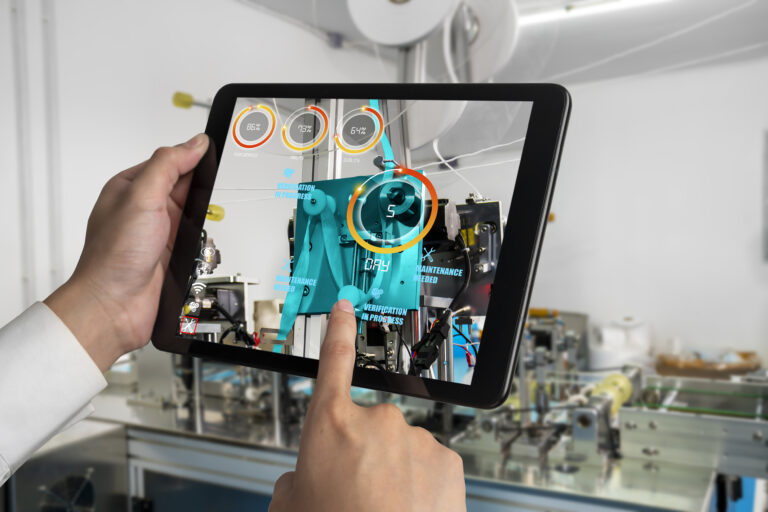
A mixture of virtual reality and physical reality is called mixed reality (also known as augmented reality, or AR for short). In augmented reality, computer-generated objects are added to reality. An additional layer of information is added to the real world using a mobile device. The AR system scans the real environment and identifies geometric surfaces and objects. This allows the digital object to be optimally superimposed on the real world.
There are already numerous examples of applications for augmented reality. AR product configurators allow users to customize products in real time and display them as 3D models in the room. Event organizers can use AR to create new experiences for visitors. AR is used in architecture and landscaping: buildings and plants can be virtually placed in the room. Augmented reality is ideal for interior design and furniture. Customers can use it to see how objects look in their room. There are also many other possible applications in training, navigation, shopping, gaming, social media, etc.
Augmented reality in technical communication
Augmented reality opens up many new possibilities for technical documentation. Displaying additional information on real objects can be very useful for accomplishing complex tasks. Suitable areas of application in industry include production and manufacturing, maintenance, service and repair as well as education and training.
Users have to switch back and forth between the machine and the technical documentation. With AR glasses, the information can be transferred directly into the environment and the user has their hands free to operate machines or devices. The information is displayed in real time, dynamically and tailored to the user’s current situation. Such information can be components or safety instructions, content can be translated live, missing material or spare parts can be ordered directly from the application. For example, a service technician can be guided step-by-step through maintenance using an AR solution or undergo training on an unfamiliar machine.
Advantages and disadvantages of augmented reality
AR differs from VR in terms of the degree of virtuality and this is precisely where the advantage lies, as a low degree of virtuality means greater user acceptance. Smartphones and tablets are widely used, so there are already many AR applications on the end customer market. The possibilities with AR are almost endless. They promise to be scalable and save costs. Even end users themselves could use AR solutions to carry out minor repairs or diagnose problems themselves.
However, unlike VR, AR applications can only be used directly on site. So that service technicians have both hands free, the use of AR glasses makes perfect sense. However, the end devices are still very expensive. Development and effort for technical editors are very high.
Where does VR/AR stand in technical communication today?
Are virtual reality and augmented reality applications just hype in the industry or will they become a permanent fixture? We are convinced that both VR and AR applications can offer high added value in technical communication.
In order to create the right virtual experiences for users, a corresponding database must be available. An intelligent, topic-based provision of all of a company’s information is crucial. Data must be made available in a structured and automated way. We believe that the breakthrough of VR/AR must first be achieved with the end user so that corresponding applications spread and new formats are created. For large-scale use, the costs must first fall and the technologies must be generally available. The following prerequisites are currently decisive for the use of VR/AR in a technical editorial department: target definition, target group analysis, identification of a suitable use case and a cost-benefit analysis.
We see great potential for Industry 4.0 and the future of technical documentation, particularly in AR applications.

Maximilian Gärber
Technical Consultant | PANTOPIX
We will be happy to inform you regularly about new articles, videos or podcast episodes.

Knowledge
Learn more about connecting information