Knowledge Graph Embeddings: How vectors extend knowledge graphs
21. February 2024
Combining different data sources in a knowledge database and the semantic representation of the information contained therein can make technical communication much easier. Building a knowledge base using semantic knowledge graphs offers numerous advantages, including the important possibility of continuously expanding the knowledge graph. One method of expanding knowledge is the use of knowledge graph embeddings.
What are knowledge graphs?
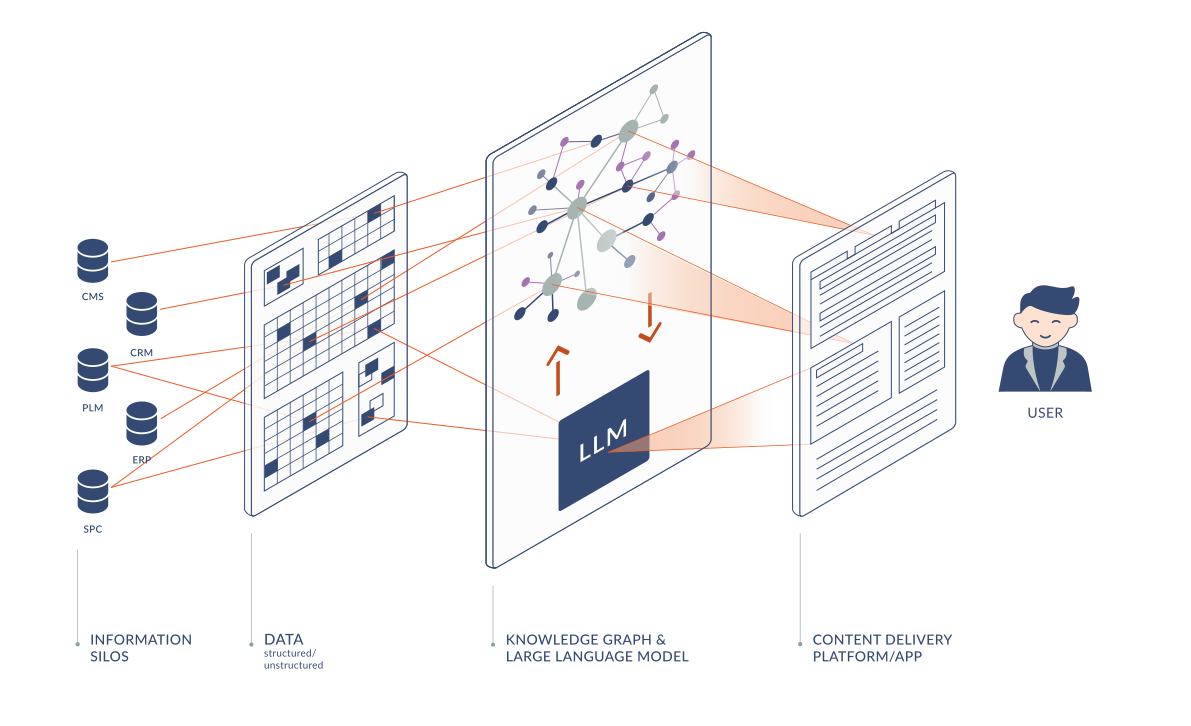
Knowledge graphs enable the virtualization and networking of information that is available in various information silos in structured and unstructured form. In order to integrate the knowledge of a company or specific company divisions, it is first described and modeled in a systematic and abstract way. The information from the various information silos is then integrated into this model. The challenge in modeling is to identify the relevant classes and relationships that are important for future applications. As a rule, existing concepts of metadata, information models or nomenclatures are used and processed automatically.
The difficulties of knowledge graphs often lie in data incompleteness and the challenge of effectively modeling complex semantic relationships between entities.
Knowledge graph embeddings offer an interesting way to improve the representation of knowledge in knowledge graphs and overcome some of the challenges associated with them.
Knowledge Graph embeddings - short and sweet
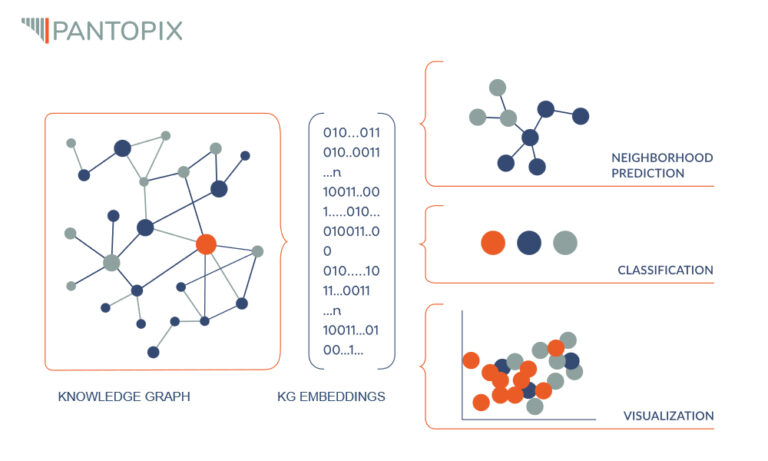
Knowledge graph embeddings aim to map and preserve the entities and relationships represented in knowledge graphs in a vector-based space. Embeddings make it possible to capture complex relationships between entities and support applications such as knowledge graph search, question-answer or recommendation systems.
There are various approaches for creating knowledge graph embeddings, including TransE, RotatE, CompGCN and many others. These models use various techniques to capture the structure and semantics of knowledge graphs and represent them in vector form.
How do Knowlege Graph Embeddings complement knowledge graphs?
The integration of Knowledge Graph Embeddings (KGEs) in knowledge graphs offers several advantages. Here is a small selection:
Semantic representation: Knowledge graph models can have difficulty correctly capturing semantic similarities between entities. KGEs enable a more accurate representation of semantic relationships and can thus better understand complex patterns and semantics.
Data incompleteness: KGEs can be used to predict missing links and thus complete the knowledge graph.
Relationship information: Traditional knowledge graph models often represent relationships as simple edges between entities. But through vector-based representation, KGEs make it possible to capture complex relationships between entities.
The use of KGEs in knowledge graphs improves applications such as recommendation systems, question-answering systems, and search by enabling deeper semantic analysis and understanding.
In Anlehnung an neo4j Illustration von KGE.
Recording: Knowledge Graph Embeddings in the Industry
Knowledge graphs are extremely useful when we need to compare hierarchical relationships, properties and links of different data models. They allow users to analyze different data properties of data models to solve industrial problems without having to understand the semantics of the data model. In this presentation we will discuss the following:
Use of semantic relationships and properties to represent data from different sources
Methods currently used to analyze and represent semantic relationships between different nodes in knowledge graphs
Use of these methods to solve various problems in industry, with proven examples