



Use Cases
Enterprise Knowledge Hub: Networking knowledge. Accelerate decisions.
The basis for companies that want to bundle their knowledge centrally, link it intelligently and translate it into real added value.

In many companies today, knowledge is distributed: Product data in the PIM, content in the CMS or CCMS, transaction data in the ERP, empirical knowledge in heads and documents.
However, the real added value only arises when this knowledge is brought together, understood and made usable – across system boundaries.
An enterprise knowledge hub creates precisely this foundation:
It combines data, content and context into a central, networked knowledge base.
Initial situation
Why isolated data and systems become a problem
Companies have enormous amounts of information at their disposal, but this is often:
- fragmented across many systems
- ambiguous or contradictory
- Difficult to access for different target groups
- Not contextualized for specific use cases
As a result, knowledge is not used, decisions take longer and potential remains untapped.
Limits of classical knowledge approaches
Data silos instead of networking
Inconsistent database
Lack of contextualization
Limited scalability

Change of perspective
What is an Enterprise Knowledge Hub?
An enterprise knowledge hub is more than just a data platform. It is the semantic basis for networked knowledge within the company.
It ensures that information:
- are centrally available as a single source of truth
- are semantically linked and clearly interpretable
- be provided contextually for different use cases
- can be used consistently across systems
- serve as a basis for automation and AI
At the heart of this is often a knowledge graph that makes relationships between data visible and structures knowledge. Instead of isolated data, a networked knowledge ecosystem is created.
Application scenarios
Where an enterprise knowledge hub creates real added value
A central product information platform bundles all relevant product data from different systems and makes it consistently available. It creates a standardized database that can be accessed by all departments – from marketing to sales to service. This reduces coordination efforts and minimizes sources of error. At the same time, it forms the basis for a scalable and future-proof information architecture.
Digital product catalogs and navigators provide intuitive access to complex product portfolios. Users can compare products, understand variants and find the right solution. The intelligent linking of data creates dynamic information spaces instead of static lists. This not only improves the user experience, but also speeds up decision-making processes in sales.
Knowledge-based assistance systems access the Knowledge Hub to provide users with contextually relevant information. They support employees or customers with questions, problems or decisions in real time. By linking data and context, they provide more precise answers than traditional search systems. This increases efficiency, quality and speed in day-to-day work.
Digital twins and the digital product passport require consistent, structured and networked information across the entire life cycle of a product. An enterprise knowledge hub ensures that this data is maintained centrally and provided in context. This creates transparency – from development and use through to recycling. At the same time, regulatory requirements can be met efficiently.
AI applications require high-quality, networked and interpretable data in order to develop their full potential. An enterprise knowledge hub provides precisely this basis by semantically structuring and correlating data. This allows processes to be automated, predictions to be improved and new digital services to be developed. The knowledge hub thus becomes an enabler for sustainable innovation through artificial intelligence.
PANTOPIX & Enterprise Knowledge Hub
Think knowledge holistically and network strategically
For us, an enterprise knowledge hub is not an isolated IT project, but a central component of modern information architectures. The focus is not on the technology alone, but on the question: How can knowledge really be used in the company?
Development of a central knowledge base (knowledge graph)
Integration of PIM, CMS, ERP and other systems
Modeling domain knowledge and relationships
Scalable architecture for future use cases
Basis for AI-supported applications
Consistent use of knowledge across all channels
PANTOPIX SPHERE
The Enterprise Knowledge Hub as the basis for intelligent applications
An enterprise knowledge hub only develops its full value through concrete applications.
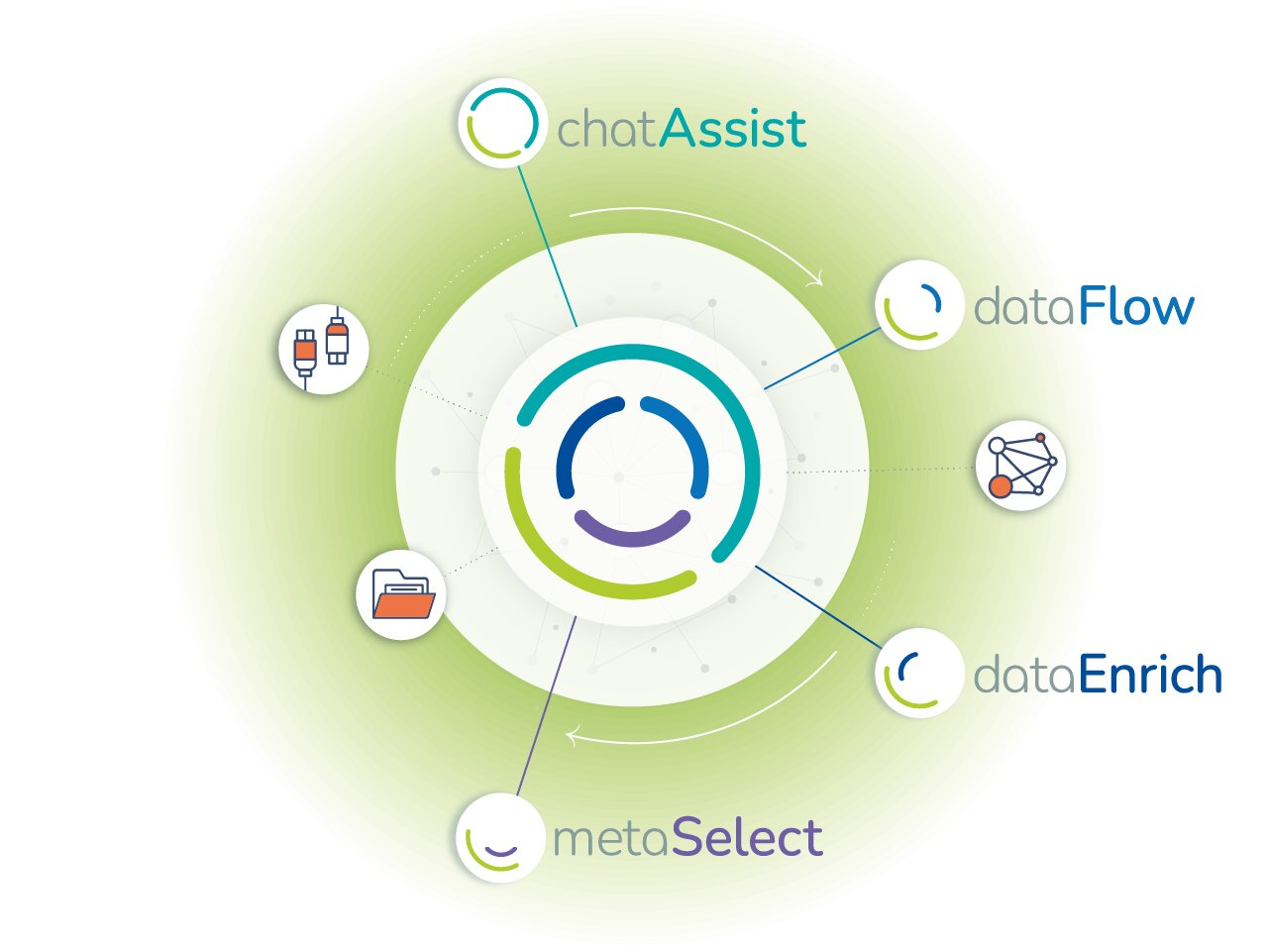
With an integration layer such as PANTOPIX SPHERE, content, data and knowledge are not only connected, but actively made usable.
This creates a platform that:
- Information semantically linked
- Automatically creates context
- Applications dynamically supplied with knowledge
The step from data management to genuine knowledge management is thus becoming a reality.
FAQ
Frequently asked questions about Enterprise Knowledge Hub

What is an Enterprise Knowledge Hub?
An enterprise knowledge hub is a central platform that brings together and links data, content and knowledge from different systems. In contrast to traditional systems, it is not just about storing information, but also about structuring and contextualizing it semantically. This creates a uniform, consistent knowledge base – a so-called “single source of truth”. This forms the basis for using knowledge efficiently throughout the company and making it available in a wide variety of applications.
What is the difference to a PIM system?
A PIM system is primarily used to store and manage data in a specific context. An enterprise knowledge hub goes beyond this by semantically linking this data and making its meaning visible. Relationships between information are explicitly modeled so that correlations can be understood and used. This turns isolated data into a networked knowledge system that can be used flexibly for different applications.
When is an Enterprise Knowledge Hub worthwhile?
An enterprise knowledge hub is particularly worthwhile for companies with complex products, many data sources or high demands on the consistency and timeliness of information. If information is distributed across different systems and needs to be used in different contexts, a traditional architecture quickly reaches its limits. The Knowledge Hub creates a central basis for efficiently bundling knowledge and making it reusable. At the same time, it opens up new possibilities for digitalization, automation and the use of AI.
What role does a knowledge graph play?
The knowledge graph is the central element of an enterprise knowledge hub and maps the semantic structure of knowledge. It describes how data, content and entities are related to each other and makes these relationships machine-interpretable. This means that information can not only be stored, but also understood and used intelligently. The knowledge graph makes it possible to answer complex questions and forms the basis for advanced applications such as personalized information provision or AI-supported processes.
Why is PANTOPIX the right partner for implementing an Enterprise Knowledge Hub?
PANTOPIX combines strategic consulting with technical implementation expertise and many years of experience in the design of complex information architectures. The focus is not only on the technology, but also on the question of how knowledge can be meaningfully structured and utilized within the company.
Our expertise in building knowledge graphs and integrating existing systems results in sustainable solutions instead of isolated individual projects. In this way, PANTOPIX develops scalable knowledge platforms that create real added value and serve as the basis for future innovations.
Your question is not listed?
We are happy to answer all open questions personally and without obligation.

Contact person
Our expert for enterprise knowledge hubs

Karsten Schrempp